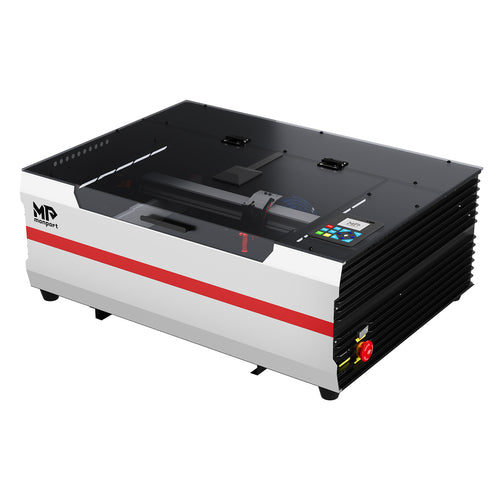
A realistic laser engraving business startup cost in 2026 is about $2,500 to $4,500 for a lean home-based test setup, $5,500 to $9,500 for a versatile small-business CO₂ setup, and $10,000 to $20,000 or more for a production-focused workshop.
Those figures cover more than the laser. A workable launch budget may also need to pay for exhaust, cooling, electrical work, software, test materials, safety equipment, packaging, business registration, insurance, selling fees, marketing and cash for the first few months of operation.
The right number depends on the products you intend to sell. An acrylic sign shop, a tumbler business and a metal-tag service require different machines, accessories and production workflows. If the business model is still unclear, begin by choosing a customer and product family. This guide to building a home laser engraving business explains how the offer, pricing and sales process fit together.
Pricing method: Dollar figures in this article are U.S. planning estimates. Public machine, software and marketplace prices were checked on . Promotional prices, taxes, freight, local permits, electrical work, insurance and rent can change the final total. Replace every allowance with a current quote before buying.

Quick Answer: Three Practical Startup Budgets
| Startup level | Planning range | Worked example | Best fit |
|---|---|---|---|
| Lean home validation | $2,500–$4,500 | $3,099 | Testing a narrow product range with an existing computer and suitable workspace |
| Versatile small-business CO₂ setup | $5,500–$9,500 | $8,250 | Regular wood, acrylic, leather, signage and personalized-gift production |
| Production-focused workshop | $10,000–$20,000+ | $18,000 | Larger machines, dedicated infrastructure, higher volume or more than one process |
The worked examples below show exactly how those totals were built. They are planning models, not industry averages or vendor quotations. Taxes, loan interest, owner salary and a leased-shop deposit are not included.
Choose the Products Before You Choose the Laser
The cheapest laser is expensive when it cannot process the material, size or order volume your customers need. Before comparing machines, define:
- The first three products you plan to sell.
- The material, thickness and maximum size of each product.
- Whether the item is engraved, cut or both.
- The expected batch size and weekly order volume.
- The full process after the laser stops, including cleaning, assembly, proofing and packing.
If you need ideas, review these laser engraving business niches, then check every proposed substrate against a laser material compatibility guide and the machine manufacturer’s instructions.
| Laser type | Typical business use | Effect on the startup budget | Important limitation |
|---|---|---|---|
| Diode | Selected wood, leather, slate, coated tumblers and some opaque acrylic products | Often the lowest equipment commitment for product validation | Cutting speed, batch capacity and material range may be limited; clear acrylic is not a normal diode workflow |
| CO₂ | Wood, clear and colored acrylic, leather, paper, fabric, coated glass, signs and gifts | Requires an exhaust plan and, depending on the machine, water cooling and more workspace | Not the correct source for direct engraving of most bare metals |
| Fiber or MOPA | Bare-metal jewelry, tools, identification plates, promotional products and industrial marks | The machine may be compact, but fixtures, lenses and product-specific testing still need a budget | Not a substitute for a CO₂ workflow built around wood or clear acrylic cutting |
| UV | Certain plastics, glass and heat-sensitive precision applications | Usually a specialized purchase that should follow a defined product and customer need | A higher equipment cost can be difficult to justify without validated demand |
For signs, décor and personalized nonmetal products, compare the current CO₂ laser range. For direct metal marking, start with the fiber laser range instead. Wattage alone does not make one laser suitable for every material.
Laser Engraving Business Startup Cost Breakdown

1. Laser Machine and Production Accessories
The laser is usually the largest single purchase, but the advertised price may not represent a production-ready system. Ask whether the quotation includes:
- Cooling equipment and coolant requirements
- Air assist
- Exhaust fan, ducting or filtration
- Honeycomb and blade beds
- Camera alignment or autofocus
- Rotary compatibility
- Pass-through or conveyor support
- Control software
- Delivery, lift-gate service and installation
- Taxes and initial spare parts
For a current price reference, Monport’s 60W CO₂ laser product page showed a promotional price of $2,249.99 when reviewed. Its larger Effi10S 100W CO₂ model was listed at $5,999.99. Use the live product page and checkout as the final source because promotions, configurations and shipping conditions change.
A machine that costs more upfront can still be the lower-cost option if it includes cooling, offers the required bed size and removes a manual step from every order. The reverse is also true: unused capacity and accessories tie up cash without creating sales.
2. Exhaust, Cooling, Electrical Work and Workspace
Smoke extraction is part of the machine installation, not an optional upgrade. A garage window, basement, spare room and commercial workshop can require very different solutions.
Your quote may need to include ducting, an inline fan, an exterior vent, a filtration unit, replacement filters, cooling equipment, a suitable electrical circuit and a stable worktable with clearance around the machine. If you cannot vent outdoors, obtain a filtration recommendation based on the actual materials and expected production volume rather than buying a generic unit by size alone.
Never process an unknown material. Labels such as “plastic,” “vinyl” or “synthetic leather” do not establish laser compatibility. Read the safety data supplied by the material vendor and follow the machine manufacturer’s operating instructions. A general home laser safety guide is a useful starting point, but it does not replace local fire, electrical or workplace requirements.
3. Computer and Software
If you already own a compatible computer, this category may be limited to software and backup storage. A dedicated production computer, monitor and file-backup process can add several hundred dollars.
At the time of review, the official LightBurn store listed LightBurn Core at $99 and LightBurn Pro at $199. The correct license depends on the machine controller, so confirm compatibility before purchasing. For setup support, see this beginner’s guide to connecting a laser to LightBurn.
You may also need vector-editing, photo-preparation, order-management, accounting and cloud-backup tools. Record recurring subscriptions as monthly costs rather than hiding them in the initial purchase.
4. Materials, Samples and Product Testing
Do not spend the entire startup budget on equipment and leave no money to develop products. The first material order should support a narrow, testable product family. For an acrylic sign business, that might mean two or three colors, a limited set of thicknesses, masking, adhesive, mounting hardware and correctly sized packaging.
Budget for more than sellable stock. You will consume material while finding settings, testing suppliers, making photography samples and correcting failed cuts. A simple starting formula is:
Opening material budget = Sellable launch inventory + test sheets + expected waste + sample and photography stock
Keep a test log for material supplier, thickness, machine settings, result and failure reason. The log turns early waste into reusable production knowledge.
5. Safety, Registration, Insurance and Professional Advice
Safety expenses can include a suitable fire extinguisher, smoke detection, manufacturer-required eye protection, safe material storage, first-aid supplies and electrical inspection. An operating laser should be supervised in accordance with the manufacturer’s instructions.
Business costs may include entity or business-name registration, sales-tax registration, a local license, a home-occupation permit, general or product liability coverage, equipment coverage, bookkeeping and tax advice. Requirements vary by state, city, product and workspace, so obtain local answers instead of copying another shop’s allowance.
Laser equipment used in a business may also have tax and depreciation implications. The IRS depreciation overview explains that qualifying machinery and equipment can be depreciable property, but a tax professional should apply the rules to your circumstances.
6. Packaging, Selling Fees and Marketing
A completed engraving is not a completed order. Include boxes, protective inserts, labels, product photography, sample pieces, shipping damage, returns and customer replacements.
If you sell on a marketplace, calculate fees from the full transaction instead of entering one round percentage. Etsy’s current fees policy lists a $0.20 listing fee and a 6.5% transaction fee; payment processing and other charges vary by seller location and transaction. Recheck the policy when you price a product.
New marketplace sellers can also use this laser buying guide for Etsy shops to match the machine to product size, material and order volume.
7. Working Capital
Working capital is the cash left after installation. It pays for material reorders, filters, cleaning supplies, repairs, refunds, replacement shipments, advertising tests and slow-paying business customers.
Set the reserve from risk rather than a universal percentage:
Minimum reserve = one month of fixed operating costs + one normal material reorder + a repair or remake allowance
If the business depends on seasonal stock, long supplier lead times or paid advertising, hold more. A startup plan that leaves the bank balance at zero after delivery is underfunded even when the equipment is fully paid.
Three Itemized Laser Engraving Startup Budgets
The following models make the headline ranges reproducible. Replace each figure with a dated quote and note whether tax and delivery are included.

| Budget item | Lean validation | Versatile CO₂ shop | Production workshop |
|---|---|---|---|
| Laser machine | $700 | $3,000 | $6,000 |
| Exhaust, cooling and installation | $450 | $600 | $2,500 |
| Computer and software | $99 | $700 | $1,200 |
| Starter materials and testing | $300 | $700 | $1,500 |
| Safety, workbench and tools | $300 | $550 | $1,000 |
| Registration and initial insurance allowance | $300 | $500 | $1,000 |
| Packaging and store setup | $200 | $300 | $500 |
| Launch marketing | $150 | $400 | $800 |
| Working-capital reserve | $600 | $1,500 | $3,500 |
| Illustrative total | $3,099 | $8,250 | $18,000 |
What the Lean Budget Assumes
The $3,099 model assumes you already own a computer, have a suitable home workspace and are testing a few small products. Its main constraint is capacity. A lower-cost machine can validate demand, but slow cutting or a small working area may become expensive when orders require repeated setups.
What the Versatile CO₂ Budget Assumes
The $8,250 model allocates $3,000 to the laser and keeps $1,500 in reserve. It is designed for a small home-based operation making wood, acrylic, leather, signs, décor or personalized gifts. It does not assume that every accessory is required on day one.
What the Production Budget Assumes
The $18,000 model allows for a larger machine, stronger extraction, electrical or workspace changes, more test stock, fixtures and a larger reserve. A leased unit, payroll, a second laser or substantial inventory can push the total beyond $20,000 quickly.
Estimated Monthly Operating Costs
Startup cost answers “Can I open?” Monthly cost answers “Can I keep operating?” Separate fixed costs from costs that rise with each order.
| Illustrative monthly fixed cost | Example allowance | What to replace it with |
|---|---|---|
| Insurance and business administration | $100 | Your monthly premium, license and bookkeeping allocation |
| Software and cloud services | $50 | Your actual subscriptions and update plan |
| Workspace and base utilities | $150 | Home-workspace allocation or commercial rent and utilities |
| Maintenance and filter reserve | $100 | Expected service parts, cleaning supplies and filter schedule |
| Marketing tests | $200 | Your defined customer-acquisition budget |
| Internet and general administration | $50 | The business share of actual costs |
| Illustrative monthly fixed total | $650 | Use for the worked example only |
Material, packaging, transaction fees, direct labor, seller-paid shipping and electricity attributable to production belong in the per-order calculation. Record them separately so a higher sales volume does not create the illusion of higher margin.
Maintenance is easy to underestimate. Budgeting for cleaning and consumable parts is cheaper than treating downtime as a surprise. Review a practical CO₂ laser maintenance routine and price likely replacements from the laser accessories and parts catalog for the machine you are considering.
How to Calculate Cost per Order and Break-Even

Build the Unit Cost From the Entire Workflow
This example uses an engraved product sold for $48. It is not a claim about typical market pricing. It shows how to expose costs that disappear when a seller counts only the blank.
| Per-order item | Illustrative amount | Calculation note |
|---|---|---|
| Selling price | $48.00 | Amount charged before sales tax |
| Blank material and hardware | $7.00 | Use the landed cost, not the supplier price alone |
| Expected waste | $1.50 | Testing, defects and remake allowance |
| Direct labor | $8.00 | 20 minutes at an assumed labor rate of $24 per hour |
| Machine and workspace allocation | $3.00 | Electricity, wear and production-space allowance |
| Packaging | $3.00 | Box, protection, label and packing consumables |
| Marketplace and payment fees | $5.00 | Replace with the actual platform calculation |
| Seller-paid shipping allowance | $2.00 | Include only the portion not recovered from the buyer |
| Total variable cost | $29.50 | Cost that changes with the order |
| Contribution margin | $18.50 | $48.00 − $29.50 |
Calculate Monthly Break-Even
Break-even units = Monthly fixed costs ÷ Contribution margin per unit
Using the two examples above:
$650 ÷ $18.50 = 35.14
Because a partial order cannot be sold, the business needs 36 orders per month to cover the illustrated fixed costs. This follows the standard break-even logic described by the U.S. Small Business Administration.
Calculate Equipment Payback Separately
Break-even and payback answer different questions. Break-even asks how many units cover a normal month. Payback asks how long operating cash may take to recover the startup spending.
Simple payback period = Startup spending to recover ÷ Monthly cash generated after operating costs
Suppose the versatile model spends $6,750 and retains its $1,500 reserve. At 55 orders per month, the illustrated contribution is $1,017.50. After $650 of fixed costs, $367.50 remains before tax, debt payments and owner draws. Under those assumptions, simple payback is about 18.4 months.
This is a scenario, not a forecast. If demand, labor time, fees or remakes change, recalculate. Revenue alone should never be used as the payback amount.
Check Production Capacity Before Believing the Break-Even Number

A profitable spreadsheet can still describe an impossible workload. Time the complete process: customer messages, artwork, proofing, setup, laser time, cleaning, assembly, quality control and packing.
For example, a six-piece batch might require 15 minutes of setup, 25 minutes of machine time and 20 minutes of finishing and packing. That is 60 minutes for six sellable units, or approximately six units per labor hour before rework. Five productive hours per week would support about 30 units, not an unlimited number of orders.
If every custom order adds 15 minutes of design and proofing, capacity falls even when laser speed does not change. Compare machines using sellable units per hour and setup time, not maximum engraving speed alone.
What to Buy Now and What Can Wait
| Buy before launch | Add after demand is proven |
|---|---|
| A material-compatible laser | A second machine |
| Required exhaust and cooling | A conveyor system |
| Fire and workspace safety equipment | Specialty lenses with no immediate product use |
| Basic tools, jigs and test materials | Large bulk inventory |
| Packaging for the first product family | Premium packaging upgrades |
| Required registration and appropriate insurance | Broad paid-advertising campaigns |
| A working-capital reserve | Accessories unrelated to validated products |
A rotary belongs in the first column when tumblers or cylindrical products are central to the launch. Otherwise, it can wait.
Should You Pay Cash, Finance the Laser or Validate First?
Cash avoids interest but can leave the business without operating reserve. Financing preserves cash but adds a fixed monthly obligation before demand is proven. A smaller validation setup reduces commitment but may create a capacity bottleneck.
Before accepting financing, compare the down payment, total of payments, fees, early-payoff terms, required insurance and warranty conditions. Add the payment to monthly fixed costs, then run the break-even calculation again. If the new order target exceeds realistic capacity or validated demand, the financing does not solve the underlying problem.

Is a 70W CO₂ Laser Worth the Startup Cost?
A 70W CO₂ laser can make sense when the business needs clear-acrylic processing, a larger working area, camera-assisted placement and repeatable small-batch production. It may be excessive for occasional small wood engravings and is the wrong category when direct bare-metal marking is the primary service.
The Monport MEGAS 70W provides a 700 × 350 mm working area, an 8MP camera, autofocus, built-in water cooling, batch-layout features and conveyor support. Those features have value only when they reduce setup time, expand the sellable product range or support repeat orders. This MEGAS material guide can help you compare that workflow with the products you plan to make.
Use three questions to judge the upgrade:
- Does the bed fit the largest product or batch you expect to sell?
- Does the machine reduce paid labor or failed placement often enough to matter?
- Can the remaining budget still cover installation, materials and reserve?
If any answer is no, validate the offer before paying for unused capability.
A 30-Day Validation Plan Before You Buy
Week 1: Define a Narrow Offer
Choose one customer group and three related products. Record the material, dimensions, production steps, expected price, packaging and reason the customer would choose your version.
Week 2: Collect Dated Quotes
Quote the machine, delivery, exhaust, electrical work, software, materials, insurance and packaging. Mark whether each price includes tax, freight and required accessories. Use the SBA planning resources linked above to separate one-time and monthly costs.
Week 3: Test Willingness to Pay
Create realistic samples or mockups and present them to qualified buyers. Set a pass criterion before the test. For example, you might require five paid orders or deposits at the target price rather than counting likes or compliments. The correct threshold depends on your market, but it should measure purchasing behavior.
Week 4: Time the Workflow and Recalculate
Time design, proofing, setup, production, finishing and packing. Calculate contribution margin, monthly break-even volume, weekly capacity and the remaining cash reserve. Compare the result with your actual test orders.
When the offer is validated and you are ready to compare production systems, Monport’s small-business laser selection page provides another route to evaluate equipment by workflow.
Common Budgeting Mistakes
- Budgeting only for the laser: A machine without extraction, materials, packaging and reserve is not a complete launch.
- Choosing by wattage alone: Laser source, bed size, material compatibility and workflow matter more than one specification.
- Treating owner labor as free: Custom artwork, customer messages and packing consume capacity even when the laser is idle.
- Using revenue as profit: Fees, waste, labor and overhead must be deducted first.
- Buying inventory before testing demand: A narrow product family produces better cost data and less stranded stock.
- Assuming financing improves affordability: A smaller upfront payment can increase monthly break-even.
- Ignoring downtime: Cleaning, replacement parts and supplier delays should appear in the plan.
Frequently Asked Questions
Can you start a laser engraving business for under $1,000?
You may be able to buy an entry-level machine and a few blanks for less than $1,000. A complete business setup usually costs more after exhaust, safety equipment, software, packaging, registration and working capital are included.
What is the biggest startup expense?
The laser is usually the largest single purchase. Infrastructure and working capital can still represent a large share of the total, especially when the workspace needs electrical or ventilation changes.
Should a new business buy a CO₂ or fiber laser?
Choose CO₂ for a product range centered on wood, acrylic, leather, paper and similar nonmetals. Choose fiber or MOPA when direct marking or engraving on suitable bare metals is the main service.
How much does it cost to run a laser engraving business each month?
There is no reliable universal average. Add insurance, subscriptions, workspace, maintenance, marketing and administration to create the fixed-cost total. Then calculate materials, waste, labor, packaging, fees and seller-paid shipping per order. The worked example in this guide uses $650 in monthly fixed costs solely to demonstrate the method.
How much should you budget for laser engraving materials?
Budget for sellable inventory, parameter testing, samples, photography, failed blanks and remakes. Start with enough material for a narrow product family rather than stocking every color, thickness and blank before demand is known.
Do you need an LLC to start a laser engraving business?
Not in every situation. Business structure, tax, licensing, home-occupation and insurance requirements vary by location and activity. Check the rules for your state and municipality and obtain professional advice when needed.
Is buying a used laser a good way to reduce startup cost?
It can be, but price the risk. Confirm controller and software compatibility, tube or source condition, optics, cooling, exhaust, replacement-part availability, transferability of support or warranty, and the cost of moving the machine. A low purchase price is not a saving if an immediate repair stops production.
Is a laser engraving business profitable?
It can be when customers buy at prices that cover materials, waste, labor, fees, overhead and customer acquisition. Equipment ownership alone does not create demand or guarantee profit.
Final Budget Checklist
- Define the first customer and product family.
- Match the laser source to the exact materials.
- Confirm the required bed size and realistic batch capacity.
- Quote delivery, accessories and installation.
- Plan exhaust, cooling, electrical service and workspace safety.
- Add computer, software and file backup.
- Include testing stock, samples, waste and remakes.
- Verify registration, permits, tax obligations and insurance.
- Calculate packaging, marketplace, payment and shipping costs.
- Pay yourself for design, proofing, production and administration time.
- Separate monthly break-even from startup-cost payback.
- Keep working capital after the equipment is installed.
For many first-time sellers, a complete budget of $5,500 to $9,500 is a reasonable planning range for a versatile home-based CO₂ business. A leaner setup can validate a narrow offer, while a production workshop can exceed $20,000 once infrastructure, rent, payroll or multiple machines are involved.
Start with the products, replace every allowance with a real quote and test willingness to pay before committing most of your cash to equipment. The best laser budget is not the lowest purchase price; it is the smallest complete system that can produce your validated offer safely, repeatedly and at a margin.