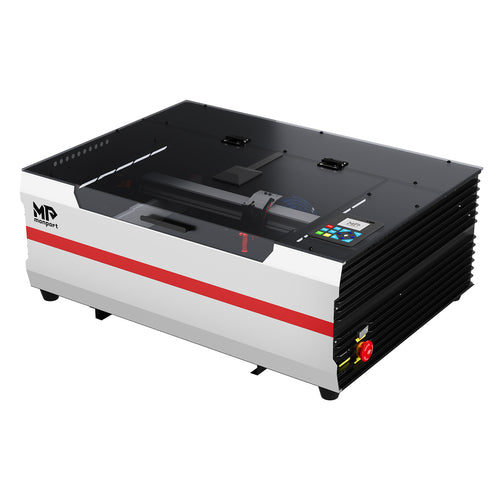
The best laser cutter for signage depends on the signs you plan to sell, the materials behind them, and how regularly you will run jobs. A machine for layered acrylic lettering has different requirements from one used for engraved wood plaques, long architectural panels, or bare-metal identification plates.
Short answer: start by comparing an enclosed CO2 laser if your core products involve cutting or engraving acrylic, wood, plywood, leather, paper, or other compatible non-metal materials. A diode laser can be a sensible fit for smaller, lower-volume engraving work. A fiber laser is the more relevant category when direct marking or engraving on bare metal is the main application.
This guide uses Monport machines and product categories as practical examples. It is not an independent laboratory ranking. Prices, configurations, availability, included accessories, and shipping terms can change, so verify the exact product variant and documentation before placing an order.
Laser Cutter for Signs: The Quick Decision
| What you want to make | First category to compare | Why it may fit | Important limitation |
|---|---|---|---|
| Acrylic letters, layered signs, menu boards, and illuminated sign components | Enclosed CO2 laser | Well suited to cutting and engraving many acrylic sheet workflows. | Acrylic type, thickness, exhaust, air assist, masking, and edge quality still need to be tested. |
| Wood signs, plaques, table numbers, and decorative lettering | CO2 laser; diode for selected small projects | Both may work with compatible wood, depending on cut depth, volume, and finish requirements. | Species, grain, moisture, plywood adhesive, charring, and finishing labor affect the result. |
| Wedding signs, event décor, and personalized flat products | Desktop or mid-size CO2 laser | One workflow can combine cutting, engraving, and repeatable layout work. | The bed should match the largest normal product, not an occasional oversized project. |
| Equipment labels, metal plaques, tools, and industrial identification | Fiber laser for bare metal; another process for selected coated surfaces | Fiber systems are designed for direct marking or engraving on many metal applications. | Alloy, field size, required depth, contrast, and safety configuration must be confirmed. |
| Long panels or repeated batch layouts | Larger-bed CO2 laser with a suitable pass-through workflow | More usable area can reduce repositioning and improve sheet layout. | Footprint, ventilation, material handling, installation, and alignment become more demanding. |
Use Monport’s laser engraving and cutting machine collection as a starting point, then narrow the choice by material, usable work area, and production workflow rather than headline wattage alone.

Start With the Signs You Will Actually Sell
A laser may be able to process several materials, but that does not mean every machine is a good production choice for every sign. Define the first product family before comparing models. The right machine should remove a recurring bottleneck in that product family.
Acrylic signs and layered lettering
Acrylic is common in logo panels, directional signs, menu boards, reception signs, wedding décor, and layered lettering. If the job requires cutting acrylic sheet as well as engraving it, an enclosed CO2 laser is usually the first category to investigate.
Do not treat “acrylic” as one uniform material. Cast and extruded sheets can behave differently, and clear, colored, mirrored, frosted, and coated surfaces may need different tests or finishing steps. Monport’s acrylic material collection can help you identify example sheet products, but it is not a universal approval for every supplier’s material.
Wood signs and engraved plaques
Wood works well for rustic signs, wall décor, business plaques, welcome signs, and engraved logos. The laser can create the cut and the graphic, but the finished product also depends on wood species, grain direction, plywood adhesive, moisture, thickness, and surface preparation.
Plan the finishing operation at the same time as the machine purchase. Sanding, masking, painting, sealing, mounting, and packaging can take longer than the laser pass. A laser-cut wood sign is not automatically weatherproof or ready to install.
Wedding and event signage
Wedding and event work often combines welcome signs, seating charts, table numbers, drink menus, place cards, tags, and decorative overlays. These products reward accurate layout, repeatable positioning, clean lettering, and quick material changes.
A rotary attachment is useful when cylindrical products such as glasses, bottles, tumblers, or candle holders are part of the offer. It is not a default requirement for a business that produces only flat signs, plaques, panels, and letters.
Restaurant and café signage
Restaurants may need menu boards, table signs, branded plaques, opening-hours panels, logo elements, and labels. In this setting, repeatability, cleanable surfaces, consistent branding, and reliable production can matter more than maximum cutting power.
Verify that the finished substrate and coating suit the intended location. A laser-cut part is not automatically food-safe, washable, UV-resistant, or suitable for direct food contact.
CO2 vs. Diode vs. Fiber for Sign Making

| Laser type | Best signage fit | Main strength | Trade-off to plan for |
|---|---|---|---|
| CO2 | Acrylic and wood signs, layered lettering, plaques, menus, and compatible non-metal cutting | Broad non-metal capability for cutting and engraving in one enclosed workflow | Cooling, exhaust, air assist, maintenance, and material verification are part of the setup. |
| Diode | Smaller signs, surface engraving, prototypes, and lower-volume compatible materials | Can offer a compact entry path for selected engraving workflows | Transparent materials, thicker cuts, enclosure design, and production throughput may limit the business. |
| Fiber | Bare-metal plaques, tools, equipment labels, parts, and industrial identification | Designed for direct metal marking and engraving applications | It is not a general replacement for a CO2 laser used to cut acrylic or wood sheet. |
For most mixed sign shops, the first decision is whether non-metal sheet processing or direct metal marking creates the majority of revenue. A product description that says “metal compatible” is not enough to identify the process. Coated-metal marking, surface coating removal, and direct engraving into bare metal are different jobs.
How to Choose a Laser Cutter for Signage?

1. Match the usable work area to your normal sign
Measure the largest sign component you expect to make regularly. Compare that measurement with the usable work area, not just the outside dimensions of the machine. Leave room for alignment, masking, jigs, clamps, and material handling.
For small products, calculate batch capacity as well. A shop producing table numbers or logo plates may gain more from fitting several pieces into one layout than from accommodating one oversized sign that is rarely ordered.
2. Separate cutting requirements from engraving requirements
Cutting and engraving stress different parts of the workflow. Cutting depends on material composition, thickness, focus, air assist, power, speed, passes, and edge-quality expectations. Engraving depends more heavily on focus, resolution, material surface, contrast, artwork, and repeatable positioning.
When comparing machines, request a sample made from the actual material and thickness you expect to sell. Ask whether the sample cut completely through, how many passes were used, what finishing was required, and whether the edge was acceptable for your customer-facing product.
3. Treat real throughput as more than head speed
Advertised maximum speed is a machine specification under stated conditions. Finished production time also includes artwork preparation, masking, loading, framing, alignment, cutting, unloading, sanding, painting, inspection, and packaging.
For signage, track finished pieces per hour or per batch. A machine with a high headline speed may not outperform a larger bed if the faster machine requires frequent repositioning or leaves more cleanup work.
4. Decide whether you need pass-through, camera, autofocus, or rotary features
- Pass-through: useful for long pieces when the machine and workspace support safe, repeatable feeding. Check alignment, material support, clearance, and whether the feature is included or optional.
- Camera: useful for printed artwork, irregular blanks, visual positioning, and selected batch workflows. It is not essential for every flat sign.
- Autofocus: useful when material thickness changes often and manual focus would slow the job.
- Rotary: useful for cylindrical products. It adds little value to a flat-sign-only workflow.
Choose features that remove a repeated production problem. Optional hardware should have a clear job in your product mix before it becomes part of the budget.
5. Check the software and file workflow
Sign-making depends on vector artwork, text, logos, repeated layouts, accurate sizing, and sometimes camera or rotary alignment. Confirm the exact controller, supported software, file formats, operating system, connection method, and license terms for the machine variant you are considering.
LightBurn’s official user guide includes documentation for device setup, material tests, cameras, rotary workflows, and troubleshooting. “LightBurn compatible” does not necessarily mean that a license is included or that every feature is configured out of the box.
6. Plan cooling, air assist, exhaust, and enclosure requirements
A signage laser needs more than a cutting head. Cooling protects the laser source, air assist helps manage the cut zone, exhaust moves smoke and fumes away from the work area, and the enclosure and interlocks help control beam exposure and access.
Measure the installation area and plan the exhaust route before ordering. Monport’s laser accessories collection and CO2 accessories collection can help you identify possible components, but the machine manual and local requirements should determine what is necessary.
7. Compare support, documentation, and replacement parts
Downtime can cost more than a small difference in purchase price. Before ordering, check warranty coverage, support contact information, manuals, alignment instructions, replacement lenses or mirrors, cooling guidance, and the process for handling shipping damage.
Review the Monport warranty policy and download center together with the product page. Documentation access matters especially when you are buying a first CO2 machine or cannot afford long troubleshooting delays.
Material Screening: What to Test Before You Accept an Order

A material label is not a complete processing specification. Use Monport’s laser engraving materials collection as a reference for compatible project materials, then verify the exact supplier, coating, adhesive, and safety information for anything you intend to process.
| Material or sign component | Typical signage task | First category to investigate | What to verify |
|---|---|---|---|
| Cast or extruded acrylic | Cutting, engraving, layered lettering | CO2 | Sheet type, thickness, color, finish, edge appearance, exhaust, and masking method |
| Plywood or solid wood | Cutting, engraving, logo work, plaques | CO2; diode for selected lighter-duty work | Species, adhesive, thickness, charring, air assist, and finishing time |
| Paper or cardboard | Cutting, scoring, prototypes, temporary décor | CO2 or diode for compatible workflows | Fire risk, airflow, focus, material density, and continuous supervision |
| Leather or selected textiles | Engraved patches, tags, and soft décor | CO2 or diode, depending on material | Tanning method, coatings, adhesives, additives, smoke, and odor |
| Anodized, painted, or coated metal | Surface marking or coating removal | Depends on the coating and process | Whether the result is a surface mark, coating removal, marking compound, or base-metal engraving |
| Bare stainless steel, aluminum, tools, or parts | Direct metal marking or engraving | Fiber | Alloy, required depth, field size, lens, contrast, and production speed |
| PVC, vinyl, or unidentified plastic | Do not assume it is suitable | Pause and verify first | Supplier specification, safety data, additives, coatings, and the machine maker’s prohibited-material guidance |
A practical test record
Before committing a full sheet or customer order, run a small test pattern and record:
- Supplier, material name, thickness, color, finish, and batch.
- Laser type, lens or focusing method, and air-assist condition.
- Speed, power, passes, focus position, and any masking used.
- Cut-through result, edge appearance, engraving contrast, smoke residue, and cleanup time.
- Whether the finished part meets the customer’s size, appearance, durability, and installation requirements.
Keep the record with a photo of the test. Settings are starting points, not universal recipes; a change in supplier or material finish can change the result.
Monport Machine Paths for Signage Workflows
The following paths are ways to organize a comparison, not independent rankings. Use the material, size, and throughput requirements above to decide which path deserves a closer review.
Desktop CO2 for small signs and mixed customization
A desktop CO2 direction can suit a workflow built around small plaques, table numbers, wedding décor, personalized gifts, and compact sign components. It is most useful when the product mix needs both engraving and cutting but usually fits within a modest work area.
Use the Monport CO2 laser collection to compare available configurations. Review the selected variant and included accessories rather than comparing only the series name.
Reno series for a growing desktop workflow
A larger desktop CO2 workflow may make sense when you are producing more layouts per job or need room for signs, décor, and multiple small pieces. The Reno Series is a starting point for comparing bed size, focusing options, software compatibility, and feature packages.
For a mid-size desktop comparison, review the current Reno 45 product configuration and confirm the exact variant, package contents, and availability before relying on any displayed specification.
Larger-bed CO2 for panels and batch layouts
If your normal products are larger, or your margin depends on placing several pieces on one sheet, compare a larger-bed CO2 machine. The current Reno 65 configuration can be evaluated by usable work area, installation requirements, cooling, exhaust, included features, and comparable material tests—not by power alone.
Fiber for direct-metal signage
If your catalog centers on bare-metal plaques, equipment labels, tools, or industrial identification, begin with the fiber category instead of forcing a CO2 machine into a metal-marking role. Confirm field size, alloy compatibility, mark depth, contrast, rotary workflow, enclosure, and eye-safety requirements before choosing a model.
Calculate the Total Cost of a Signage Laser
The machine price is only one part of a signage setup. Build the worksheet before comparing models:
| Cost category | Question to answer | Why it matters |
|---|---|---|
| Machine and selected variant | Does the displayed price apply to the configuration you need? | Bed size, camera, autofocus, controller, and included accessories may vary by variant. |
| Software | Is the license included, or is the machine only compatible? | Compatibility does not always mean the software is included. |
| Exhaust or filtration | How will smoke and fumes leave the work area? | The installation may require ducting, filtration, or both. |
| Cooling and air assist | Are the required systems built in or separate? | Missing equipment can delay installation and safe production. |
| Rotary and jigs | Will cylindrical products or repeatable alignment be part of the offer? | An accessory can improve one workflow while adding little value to another. |
| Materials and finishing | What will sheets, masking, paint, sanding, sealing, hardware, and packaging cost? | Customers buy a finished sign, not only a laser-cut blank. |
| Shipping, tax, installation, and maintenance | What costs appear after the advertised price? | The checkout total and long-term ownership cost may be materially higher. |
Do not promise that a laser will pay for itself in a fixed number of months without knowing product pricing, sales volume, labor, material waste, finishing time, shipping, and customer acquisition cost. A more useful first calculation is:
Finished-sign cost = material and consumables + labor + finishing + packaging + machine and maintenance allocation.
Compare that cost and production time with your current outsourcing or production alternative. The exercise can reveal that the most valuable upgrade is a larger bed, better exhaust, a faster finishing method, or a more repeatable fixture—not a higher wattage number.

Seven Steps to Select a Signage Laser
- Define the first product family. Choose one or two repeatable offers, such as layered acrylic signs, engraved wood plaques, or wedding table décor.
- List the exact materials. Record the supplier, sheet type, thickness, coating, adhesive, and finish wherever possible.
- Measure the largest normal piece. Compare it with usable bed area and leave room for jigs, margins, and alignment.
- Separate cutting from engraving. Identify whether the bottleneck is cut-through capacity, detail, positioning, finishing, or batch layout.
- Request a comparable sample. Ask for material, thickness, speed, power, passes, air-assist details, and edge-quality information.
- Calculate total setup cost. Include exhaust, cooling, software, rotary equipment, finishing materials, tax, shipping, and maintenance.
- Verify the live configuration. Check the product page, manual, warranty, included accessories, availability, and delivery estimate before ordering.
If you need help narrowing a Monport product family, the Monport machine quiz can be a starting point. Use it alongside your own material, size, workspace, and budget analysis.
Safety and Finishing Considerations for Sign Makers
Laser equipment can create eye, skin, fire, smoke, and electrical hazards. The FDA’s laser product guidance explains why hazard classification, beam exposure, engineering controls, and risk communication matter. Follow the manufacturer’s manual and applicable local electrical, ventilation, and fire requirements.
Material verification is part of production
- Do not process PVC, vinyl, or unidentified plastic without verifying the composition and safety information.
- Check coatings, adhesives, flame retardants, and additives, especially in plywood, leather, fabric, and composite sheets.
- Run a small test before committing a full sheet or customer order.
- Keep the machine attended during active cutting, especially with paper, cardboard, wood, and other flammable materials.
- Plan exhaust and filtration before installation rather than treating fumes as a last-minute accessory issue.
Outdoor durability needs a finishing system
A laser-cut sign is not automatically an outdoor sign. Service life depends on the substrate, UV exposure, moisture, paint, laminate, adhesive, hardware, edge sealing, mounting method, and maintenance plan. If a customer expects outdoor use, define the environment and finishing system before choosing the machine or promising a service life.
Common Buying Mistakes in Sign Making
- Choosing by wattage alone: work area, source type, software, cooling, exhaust, and workflow may matter more.
- Using a generic acrylic claim: cast, extruded, clear, mirrored, and coated sheets can behave differently.
- Confusing bed size with finished sign size: jigs, margins, clamps, and material handling reduce usable space.
- Counting maximum speed as production speed: finishing, loading, alignment, inspection, and packaging are part of every job.
- Assuming every metal sign needs the same laser: coated-metal marking and bare-metal engraving are different processes.
- Ignoring finishing labor: sanding, painting, masking, sealing, mounting, and packaging can dominate the job.
- Assuming software is included: compatibility, controller support, and license inclusion must be checked separately.
- Buying for a rare oversized project: choose around the work you will produce repeatedly.
Frequently Asked Questions
What is the best laser cutter for signage?
For general acrylic and wood signage, begin by comparing enclosed CO2 laser cutters. For smaller surface-engraving projects, a compatible diode laser may be sufficient. For direct marking on bare metal, compare fiber lasers. The right choice depends on the material, largest normal sign, production volume, and complete setup budget.
What is the best laser cutter for acrylic signs?
A CO2 laser is usually the first category to investigate for cutting and engraving acrylic signs. Confirm the acrylic type, thickness, color, masking, exhaust, and edge-quality expectations. Do not use a generic “acrylic compatible” label as a guarantee for every sheet.
Can a diode laser make signs?
Yes. A diode laser can be useful for compatible surface engraving, small wood projects, and some lower-volume sign work. Suitability depends on the material, thickness, transparency, required cut quality, enclosure, and production speed. It may not be efficient for a business built around frequent acrylic cutting.
Can a CO2 laser engrave metal signs?
It may mark certain coated or anodized surfaces with a compatible method. That is different from direct engraving on bare metal. If bare stainless steel, aluminum, tools, or parts are the main products, investigate a fiber laser instead.
Do I need a pass-through laser for signs?
You may need one when normal designs are longer than the standard work area and the machine supports safe, repeatable material feeding. For small plaques and table signs, a pass-through may add little value. Measure your actual products before paying for the feature.
Is a rotary attachment necessary for a signage business?
Only if cylindrical products such as glasses, bottles, tumblers, or candle holders are an important part of the offer. Flat signs, panels, plaques, and letters do not require a rotary attachment.
How much power does a laser need to cut sign materials?
There is no universal wattage answer. Required power depends on material composition, thickness, focus, lens, air assist, speed, passes, and acceptable edge quality. Request a test using the material and thickness you plan to sell instead of relying on a generic power threshold.
Can laser-cut signs be used outdoors?
Some can, but outdoor durability depends on the substrate and finishing system as much as the laser process. Confirm UV, moisture, paint, laminate, adhesive, edge sealing, mounting, and maintenance requirements before promising outdoor service life.
Final Recommendation
The best laser cutter for signage is the one that matches your primary material, largest normal sign, production rhythm, finishing process, and workspace.
- Choose CO2 for a broad workflow involving acrylic, wood, plywood, leather, paper, and compatible non-metal cutting.
- Choose diode for compatible surface engraving, smaller projects, and a lower-complexity starting workflow.
- Choose fiber when direct bare-metal marking or engraving is the main signage application.
- Prioritize usable work area, repeatability, exhaust, software, and support before optional features.
- Calculate the cost of a finished sign—not only the price of the machine—before making a business decision.
Once you have defined the sign types you want to sell, compare the relevant Monport machine category, verify the current configuration and documentation, and run a material test before accepting production work. A careful match between machine and signage workflow is more valuable than an impressive specification that does not solve your real bottleneck.