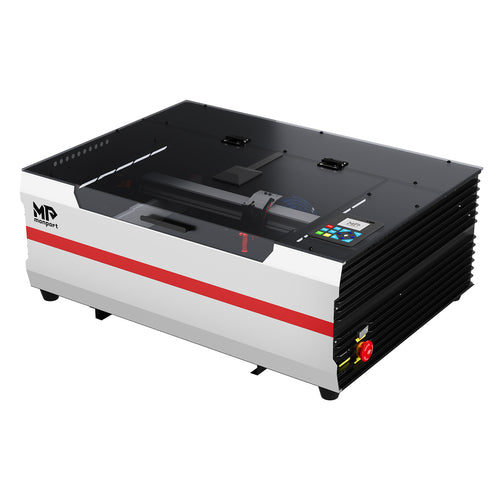
The best laser engraving machine for jewelry is the one that matches your material, surface finish, part geometry, and intended mark. A system that works well on a flat stainless-steel tag may not be the right choice for a polished ring, a plated pendant, or a finished piece with stones and adhesive.
Quick answer: for direct marking or engraving on metal jewelry, start by comparing pulsed fiber and MOPA fiber lasers. MOPA is worth investigating when pulse control could help with contrast, annealing-style effects, coating behavior, or different levels of material removal. UV may be a better application path for some delicate coatings or heat-sensitive surfaces. Diode and CO2 machines can be useful for narrower jobs or for non-metal packaging, but they should not be treated as interchangeable with a jewelry-focused fiber system.
This guide is a Monport buying guide, not an independent laboratory ranking. Product families and models are included as starting points for comparison. Live specifications, included optics, software support, warranty terms, and availability can change, so confirm the current configuration and request an application sample before processing valuable jewelry.
Quick comparison: which laser engraver should you investigate for? 
| Jewelry workflow | First category to investigate | Main buying priority | Important limitation |
|---|---|---|---|
| Names, dates, logos, or identification marks on compatible metal | Pulsed fiber laser engraver or MOPA fiber laser engraver | Contrast, detail, repeatability, and part positioning | The exact alloy and finish still need a controlled test |
| Color-related or annealing-style work on selected metals | MOPA fiber laser engraver | Pulse behavior, frequency control, and surface consistency | A MOPA laser engraver source does not guarantee the same appearance on every alloy |
| Plated or delicate surfaces where heat or coating behavior is the concern | Fiber laser engraver, MOPA laser engraver, or UV laser engraver application test | Edge control, coating response, and acceptable finish | Plating thickness and the substrate can change the result completely |
| Rings, bangles, or other cylindrical parts | A compatible fiber or MOPA laser engraver system with suitable holding equipment | Focus, access, rotary workflow, and repeatable positioning | A flat sample does not prove that an inner or curved surface will work |
| Jewelry boxes, acrylic displays, leather packaging, or paper inserts | CO2 laser engraver | Non-metal material compatibility and workflow separation | CO2 laser engraver is not the default category for direct engraving on bare precious metal |
Use the Monport laser machine collection to review the current categories, but do not choose from the category label alone. The more useful comparison is material, finish, geometry, mark objective, fixture, and production requirement.
How to choose a laser engraving machine for jewelry?
Start with the finished result and work backward. Before comparing wattage or model names, answer four questions:
- What material and alloy will be processed?
- Does the piece have plating, paint, enamel, stones, solder, or adhesive?
- Is the surface flat, curved, cylindrical, or inside a ring?
- Do you need a visible surface mark, coating removal, an annealed appearance, or actual depth?
These answers define the application more accurately than a broad phrase such as “jewelry engraving.” The same machine may be a sensible choice for one of these jobs and a poor choice for another.

1. Match the laser to the type of mark
Surface marking
A surface mark changes the appearance of the top layer without aiming for substantial material removal. Initials, dates, logos, serial numbers, and small decorative details often begin here. The target is usually clear contrast with controlled edges, not maximum depth.
Annealing or color-related marking
Annealing-style work changes the appearance of the metal through controlled heating rather than removing a deep layer. The result can depend on alloy, polish, focus, pulse settings, frequency, surface cleanliness, and lighting. Treat it as a process to validate on the actual material, not as a guaranteed capability of every MOPA machine.
Coating or plating removal
Removing a coating exposes a different layer underneath. That is not the same process as engraving into the base metal. On plated jewelry, the acceptable result depends on the plating thickness, the base material, the intended appearance, and whether the customer expects the coating to remain intact around the mark.
Depth engraving
Depth engraving removes material to create a recess. It can require multiple passes and may change edge shape, heat exposure, cleanup time, and the appearance of a polished surface. If depth matters, define the acceptable recess and edge quality before you compare machines.
2. Match the process to the material and finish
“Metal jewelry” is too broad a description for a reliable machine decision. Record the specific alloy or supplier specification, surface condition, coating, and whether the part is assembled.
Gold, silver, and other precious-metal jewelry
Gold and silver pieces can have reflective, polished, brushed, plated, or textured surfaces. Test the exact alloy and finish instead of transferring a setting from a different precious metal. A sample should show not only whether the laser creates a mark, but whether the contrast, edge, heat effect, and cleanup meet your product standard.
Plated, painted, anodized, or coated jewelry
A coating adds another process layer. You may want to preserve it, change its appearance, remove it to reveal the substrate, or create a controlled contrast. Ask for coating information where possible, then test a matching blank or rejected piece before accepting a customer order.
Stainless steel, titanium, and similar durable metals
These materials are common in tags, bracelets, watch components, charms, and industrial-style jewelry. A pulsed fiber or MOPA fiber system may be a sensible category to investigate, but the alloy, finish, lens, spot size, parameters, and desired depth still determine the usable process window.
Jewelry with stones, enamel, solder, or adhesive
The metal may be compatible while another part of the assembly is not. Stones, enamel, adhesive, soldered joints, and heat-sensitive inserts can change the risk and the acceptable process. If the non-metal component cannot be isolated, obtain technical confirmation and test on a matching loose part before putting a finished customer piece under the laser.
3. Match the machine to the geometry
Flat blanks are easier to position and focus than rings, bangles, curved pendants, and irregular charms. As curvature increases, the distance from the lens to different points on the surface changes. That can reduce usable detail or make the mark inconsistent outside the focal area.
| Part geometry | What to verify | Typical holding question |
|---|---|---|
| Flat tag or pendant | Field size, focus, edge detail, and repeatable origin | Can the design be placed in the same position on every blank? |
| Outside of a ring or bangle | Rotary motion, diameter range, focus across the curve, and artwork wrap | Does the attachment and software workflow support the actual part? |
| Inside of a ring | Inner diameter, access angle, focal distance, fixture clearance, and text size | Can the laser reach the intended inner surface without the setting or fixture blocking it? |
| Raised or irregular charm | Work height, clamping stability, focus range, and shadowing from nearby features | Can the highest and lowest points be held consistently within the usable focus range? |
A rotary attachment may help with some cylindrical work, while a ring fixture or custom jig may be more practical for a particular band or pendant. Review the Monport accessories collection for possible supporting equipment, then confirm the interface, diameter range, fixture clearance, software mode, and whether the accessory is included or sold separately.
Fiber laser engraver, MOPA laser engraver, UV laser engraver, diode laser engraver, or CO2 laser engraver: which jewelry laser fits?

| Laser category | When to investigate it | What it may help with | What still needs proof |
|---|---|---|---|
| MOPA fiber laser engraver | Metal jewelry requiring a broader process investigation | Pulse-width and frequency control for selected contrast, annealing-style, color-related, coating, or depth work | Compatibility with the exact alloy, finish, geometry, lens, and desired appearance |
| Standard pulsed fiber laser engrave | Repeatable direct marking on validated metal parts | A focused path for established metal-marking workflows | Detail, coating behavior, depth, and repeatability under your real conditions |
| UV laser engrave | Specific delicate coatings, polymers, or fine-detail applications where thermal impact is central | A different wavelength and process path for selected surfaces | Whether the exact jewelry surface, mark adhesion, contrast, and durability meet the requirement |
| Diode or infrared diode laser engrave | Limited light-marking work on selected surfaces or compact workflows | A smaller, narrower solution for compatible applications | It should not be assumed to replace fiber for depth, throughput, or broad metal coverage |
| CO2 laser engrave | Wood, acrylic, leather, paper, and other jewelry presentation products | A companion workflow for boxes, display cards, packaging, and inserts | It is not the default choice for direct engraving on bare gold, silver, or stainless steel |
When MOPA fiber laser engrave is worth comparing first
MOPA fiber is often the first category to compare when a jewelry shop wants more control over the marking process than a straightforward metal-marking workflow provides. That can matter when you are investigating contrast, annealing-style effects, color-related results, coating response, or different levels of material removal.
The value of MOPA is process flexibility, not a promise that every jewelry surface will be easy. Compare the controls exposed by the specific machine, the available lens and field options, the fixture workflow, and the application sample. If a simpler fiber process already meets the requirement, extra control may not justify extra cost or setup complexity.
When a standard fiber laser laser engrave may be enough
A standard pulsed fiber system may suit a shop that mainly marks validated metal blanks, flat tags, nameplates, or repeatable components. The buying question is whether the machine can deliver the required contrast, detail, location accuracy, and cycle time on the actual part.
Start with the Monport fiber laser engraver collection to compare the available machine paths. Review the source type, output option, work field, focusing method, enclosure, software, and included accessories together rather than treating wattage as the complete specification.
When to investigate UV laser engrave
UV may be worth an application test when the work involves a delicate coating, a polymer component, fine detail, or a surface where heat impact is a primary concern. It is a narrower solution to investigate, not a universal answer for plated jewelry.
Ask for a sample made with the exact finish and mark size. Check edge quality, contrast, adhesion, durability, and the appearance under the lighting used to inspect or sell the jewelry. A different wavelength can change the process, but it does not remove the need for material verification.
Why diode and CO2 laser engrave are not interchangeable with fiber
Some diode systems can create light marks on selected metals or coated surfaces, but a compact diode workflow should not be presented as equivalent to a fiber laser for commercial metal engraving. Confirm the actual module, material, enclosure, mark depth, repeatability, and throughput before choosing it for production.
CO2 machines are more naturally associated with non-metal materials. If your jewelry business also produces wood boxes, acrylic displays, leather packaging, or paper inserts, compare that separate requirement through the Monport CO2 laser collection. One laser does not need to be forced to cover every material in the business.
Features that matter more than the wattage number
Pulse control and process range
For metal jewelry, the available process controls can matter as much as nominal output. Ask which pulse-width and frequency adjustments are available, how they are controlled, and whether the supplier can demonstrate the desired mark on your alloy and finish.
Spot size and field lens
Small jewelry details require a suitable spot and a field size that matches the part. A larger field may cover more area, while a smaller field may be preferable for a particular detail or working distance. Changing the lens can also change focus behavior, coverage, and the practical detail you can hold.
The Monport fiber parts collection can help you review the types of optics and replacement parts used in a fiber workflow. Confirm the exact lens compatibility, working field, replacement path, and included configuration with the product page before ordering.
Focusing and work height
Focus becomes more difficult when a ring, raised setting, or irregular charm cannot sit flat. Check how the machine sets focus, how much height adjustment is available, and whether the intended fixture leaves enough clearance for the part and the lens.
Rotary, ring fixture, or custom jig
Holding equipment is part of the engraving system, not an afterthought. A rotary can help with some cylindrical surfaces, but a fixed ring fixture or custom jig may provide better control for a specific part. The fixture should prevent movement, place the mark within the usable field, and make the part easy to load in the same orientation.
Do not buy a rotary only because a product page uses the word “compatible.” Verify the machine series, attachment interface, diameter range, software workflow, clearance, and whether the accessory is included.
Software and file workflow
Confirm the controller, software license, file formats, operating system, connection method, artwork placement, and rotary support for the exact configuration. Compatibility language does not necessarily mean that every feature or license is included.
The official LightBurn user guide includes documentation for setup, material tests, focus, rotary workflows, and troubleshooting. Use the relevant machine documentation as well; software guidance cannot confirm hardware compatibility by itself.
Enclosure, extraction, and operator protection
A jewelry laser workflow should account for beam control, access controls, smoke, residue, coatings, and the workspace. Polishing compounds, adhesives, marking compounds, and unknown plastics can create hazards or contamination that are not obvious from the finished mark.
Support, replacement parts, and documentation
When customer jewelry is involved, support quality can affect both production and risk. Before purchase, review manuals, replacement optics, cleaning and maintenance instructions, warranty exclusions, shipping-damage procedures, and the available support channel.
Read the Monport warranty policy and download center alongside the live product page. Documentation is especially important if the operator is new to fiber or MOPA systems.
How much power do you need for jewelry engraving?
There is no universal wattage answer for rings, pendants, or other jewelry. The required output depends on the alloy, finish, plating, geometry, spot size, field lens, pulse behavior, speed, number of passes, desired depth, and acceptable heat exposure.
A generic chart that assigns one power level to all gold, silver, or plated steel can create false confidence. Use power as one variable in an application test, then judge the complete process by appearance, depth, heat effects, cycle time, cleanup, and repeatability.
| Process objective | Variables to compare | Acceptance check |
|---|---|---|
| Light contrast mark | Focus, spot quality, surface preparation, and process stability | Readable detail without unwanted discoloration or coating damage |
| Annealing or color-related effect | Pulse behavior, frequency, alloy, surface finish, and viewing conditions | Consistent appearance on the actual production material |
| Coating or plating removal | Coating thickness, base material, edge control, and pass count | Controlled exposure of the intended layer with acceptable surrounding finish |
| Shallow engraving | Depth, focus stability, passes, heat, and cleanup | A recessed mark with acceptable edges and production time |
| Deeper engraving or higher-throughput work | Output, heat management, lens, fixture, cycle time, and repeatability | The complete process meets the required depth and production rhythm |
When requesting a supplier demonstration, ask for the material, alloy, finish, lens, field size, process settings, number of passes, fixture, and finishing steps. A sample without those conditions is difficult to compare with your own work.
A jewelry-specific laser test workflow
The purpose of testing is not simply to make one attractive mark. It is to establish whether the process is repeatable, safe for the part, and acceptable for the product you sell.
- Describe the job precisely. Record the alloy, coating or plating, thickness if known, surface finish, part geometry, artwork size, required appearance, and whether the item is assembled.
- Use a matching sacrificial piece. Choose a matching blank, rejected piece, offcut, or supplier-approved test part. The closer it is to the production piece, the more useful the result.
- Build a controlled test grid. Include small text, a line detail, a logo or symbol, and a filled area. Change relevant variables systematically and record the machine, lens, focus, speed, power, pulse settings, frequency, passes, and fixture position.
- Inspect more than contrast. Check edge definition, heat discoloration, coating integrity, depth, residue, cleanup time, distortion, and the appearance under the lighting used by the customer.
- Test the holding method. Run the same design on multiple identical pieces. Confirm that the artwork lands in the same place and that curvature or movement does not change the result.
- Approve the process before production. Keep a record of the material, finish, artwork, intended appearance or depth, accepted sample, and the conditions used to create it. This turns a machine demonstration into a repeatable job reference.
For workflow documentation and material-test concepts, review the Monport materials collection together with the machine manual. Do not treat a general material example as proof that a particular alloy or plated component will behave the same way.
Jewelry-specific scenarios to compare before you buy
Personalized wedding bands
The main decision is usually access and repeatable positioning, not simply maximum output. Define whether the text is on the outside or inside of the band, how small it must be, and how the ring will be held. Request a sample on the same profile and finish, especially when the mark must follow a curve.
Names or logos on pendants and tags
Flat or gently curved parts may be easier to fixture than rings, but polished surfaces can make contrast and reflections more noticeable. Compare the required detail, field size, focus method, and loading repeatability. If many names change from order to order, also confirm the software and file workflow.
Plated jewelry
First decide whether the plating must remain intact or whether removing it is the intended effect. Then test the coating and substrate together. A result that exposes the base metal cleanly may still be unacceptable if the surrounding plating is discolored, lifted, or visibly uneven.
Jewelry with stones or assembled components
Identify every material near the intended mark. A metal-only test cannot validate the behavior of a stone, enamel, adhesive, solder joint, or heat-sensitive insert. Use a matching loose component whenever possible and establish a clear no-process area if the assembly cannot be separated.
Jewelry businesses that also produce packaging
Separate the metal workflow from the presentation-product workflow. A fiber or MOPA system may be the relevant path for direct metal marking, while a CO2 system may be more appropriate for wood, acrylic, leather, and paper packaging. Compare the combined purchase only after listing the materials and volumes for each workflow.
Monport product paths to review
The following are comparison paths, not a ranking. Use the application test and the live product configuration to decide whether a path fits your work.

Fiber laser collection for metal-focused work
Begin with the Monport fiber laser engraver collection when your product line centers on metal marking or engraving. Compare source type, output options, work field, focusing method, enclosure, software, optics, and included accessories.
GM 30W Pro as a compact MOPA comparison point
The Monport GM 30W Pro MOPA fiber laser can be reviewed as a compact MOPA path when you are comparing autofocus and metal-marking workflows. Confirm the current configuration, field options, included accessories, and jewelry-specific sample before treating it as a production choice.
GT 60W for more demanding metal applications
The Monport GT 60W MOPA fiber laser is a path to investigate when a validated workflow calls for more demanding metal-marking or depth-related testing. The relevant question is whether the machine, lens, fixture, and process meet the jewelry specification—not whether a higher number is automatically better.
GT 200W when higher output has a defined purpose
The Monport GT 200W MOPA fiber laser should be considered only when the actual part, depth, throughput, and cycle-time requirement justify a higher-power workflow. For small or delicate jewelry, more output may add cost and process complexity without solving a fixture, focus, or detail problem.
Calculate the total cost of a jewelry laser setup
The machine is only one part of the purchase. A useful budget should include the cost of getting the machine ready for your actual jewelry workflow.
| Cost area | Questions to answer |
|---|---|
| Machine and selected configuration | Does the displayed price apply to the source, enclosure, focus system, and field size you need? |
| Lens and optics | Which field sizes are included, and how will replacement optics be obtained? |
| Fixtures and rotary equipment | Will rings, bracelets, pendants, and irregular parts need different holding methods? |
| Extraction and filtration | How will smoke, residue, coating fumes, and workspace contamination be managed? |
| Software and computer | Is the required license included, and does it support the controller and rotary workflow? |
| Testing and rejected pieces | How many blanks or sample pieces will be used while the process is being validated? |
| Maintenance and support | What are the cleaning, alignment, replacement, warranty, and service requirements? |
| Workspace and installation | Do power, ventilation, clearance, fire controls, shipping, tax, or delivery access add cost? |
For a jewelry business, also account for approval failures. Rework, a rejected finish, a refund, or damage to a customer piece can cost more than the price difference between two machine models. A controlled test process is part of the equipment budget.
Safety and material-risk checklist
Laser marking can involve beam, reflected-light, fire, electrical, smoke, and material hazards. The FDA’s laser product guidance explains why hazard classification, engineering controls, beam exposure, and risk communication matter. Follow the machine manual and the requirements that apply in your location.
- Use the enclosure, interlocks, access controls, and protective measures specified for the machine.
- Plan extraction or filtration for smoke, residue, coatings, and marking compounds.
- Verify the material before processing; do not use unknown plastics or PVC in a laser workflow.
- Keep the machine attended during active processing unless the manufacturer’s instructions and safety system explicitly support another procedure.
- Do not make the first test on a valuable customer ring, pendant, or one-of-a-kind piece.
- Use extra caution around stones, enamel, adhesives, soldered assemblies, and heat-sensitive inserts.
- Keep eyes and body outside the controlled beam area and follow the machine’s safety instructions.
- Document the approved material and process so another operator does not guess at settings.
Common mistakes when buying a jewelry laser
- Choosing from a wattage chart alone: output does not describe the complete process window for an alloy, finish, lens, or curved part.
- Choosing for the metal but ignoring the finish: plating, polish, texture, paint, and anodizing can change the process.
- Testing a flat blank and assuming a ring will match: curvature and access can change focus, detail, and placement.
- Using “engraving” as if it meant one result: contrast marking, coating removal, annealing-style work, and depth engraving have different acceptance criteria.
- Buying a rotary without checking the complete workflow: interface, diameter, fixture, clearance, and software support all matter.
- Processing a customer piece too soon: approve the material and finish on a matching sample first.
- Ignoring optics and focus: a field lens and stable positioning may matter more than a headline power number for small detail.
- Assuming more power is always better: higher output may add cost and heat without solving alignment, detail, or repeatability.
- Forgetting the non-metal side of the business: packaging and displays may justify a separate CO2 workflow rather than an unsuitable compromise.

Frequently asked questions about laser engraving machines for jewelry
What is the best laser engraving machine for jewelry?
There is no single best machine for every jewelry workflow. For direct marking on metal, begin by comparing pulsed fiber and MOPA fiber systems. Investigate UV for a specific delicate-surface application, and consider diode or CO2 only when the material and task fit those categories. The final choice depends on the alloy, finish, geometry, mark objective, fixture, and application test.
Can a fiber laser engrave gold and silver jewelry?
A fiber laser may be suitable for selected gold and silver workflows, but compatibility is not the same as a guaranteed finish. Test the exact alloy, surface condition, desired contrast or depth, and part geometry before processing customer jewelry.
Is MOPA better than a standard fiber laser for jewelry?
MOPA may be worth the additional comparison when pulse-width and frequency control address a real need, such as contrast, annealing-style work, color-related effects, coating behavior, or process range. It is not automatically better for every job. Compare the application result, total cost, fixtures, support, and workflow complexity.
Do I need a UV laser for plated jewelry?
Not necessarily. UV may be useful for selected delicate or heat-sensitive surfaces, but plated jewelry still requires a controlled test. The plating, substrate, desired mark, edge quality, and acceptable appearance determine whether UV is appropriate.
What laser power is needed for rings?
There is no universal power requirement for rings. Diameter, alloy, finish, engraving depth, lens, spot size, fixture, pulse settings, speed, and passes all affect the result. Use a matching ring or test piece instead of relying on a generic wattage threshold.
Can a diode laser engrave jewelry?
Some diode or infrared diode systems can make light marks on selected surfaces. They should not be assumed to match a fiber laser for metal depth, production speed, or broad jewelry compatibility. Verify the exact module and material before buying for commercial work.
Can a laser engrave the inside of a ring?
It may be possible with a suitable machine, fixture, lens, and access geometry, but inner-ring work is more demanding than marking a flat blank. Check the inner diameter, ring profile, artwork size, focus distance, and rotary or fixture design as one system.
How do I protect plating and polished finishes?
Identify the finish, start with a matching sacrificial piece, use a controlled test grid, inspect heat and edge effects, and approve the process before production. No laser category can guarantee that every plated or polished surface will remain unchanged.
Can one laser handle both jewelry and wood packaging?
Compare the two workflows separately. Fiber or MOPA is the more relevant category for direct metal jewelry, while CO2 is more naturally suited to wood, acrylic, leather, and paper packaging. Some businesses use both when the product mix justifies it.
What should I test before engraving a customer’s jewelry?
Test the exact alloy, finish, geometry, artwork size, fixture, lens, process settings, cleanup method, and expected appearance. Run multiple identical samples if repeatability matters. Keep the approved process record and do not treat another machine’s settings as universal.
Final recommendation
Choose a laser engraving machine for jewelry by working backward from the finished piece:
- Identify the alloy, plating, coating, and non-metal components.
- Define the result: surface contrast, coating removal, annealing-style appearance, shallow recess, or deeper engraving.
- Measure the geometry and decide how the part will be held and focused.
- Compare fiber, MOPA, UV, diode, and CO2 according to that specific workflow.
- Request a comparable application sample and record its conditions.
- Budget for optics, fixtures, extraction, software, testing, maintenance, support, and failed approvals.
For a metal-focused jewelry business, pulsed fiber and MOPA fiber are usually the first categories to investigate. UV may make sense for a narrower heat-sensitive application, while diode and CO2 can support selected marking or presentation-product workflows.
Once the material, finish, geometry, and desired mark are documented, compare the relevant Monport fiber laser options, review the live materials resources, and confirm the exact configuration before ordering. The most defensible purchase is the one supported by a repeatable application test, not the one chosen from the largest number in a product table.