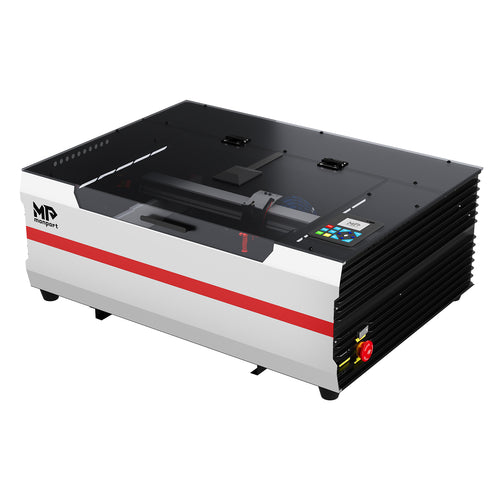
A small fiber laser cutter may occupy less space than a large industrial sheet-metal system, but “small” does not identify one universal machine design. Some systems are designed to cut through metal blanks; others use a compact scanning head primarily for engraving and marking. That distinction matters more than the name on a product listing.
For metal-cutting applications, three broad options appear in manufacturer documentation: very small enclosed precision cutters, compact enclosed CNC cutters, and relatively small professional sheet-processing systems. They differ in usable work area, workpiece handling, intended output, and facility requirements. This guide explains those differences so readers can understand what published specifications actually mean. It also clarifies where Monport fiber and MOPA equipment contributes to metalwork without confusing engraving with full sheet-metal cutting.
Last reviewed: October 27, 2026. The equipment categories and example work areas below reflect manufacturer-published information; verify current specifications and configurations before relying on them.
What Counts as a Small Fiber Laser Cutter?
The term small fiber laser cutter can describe a limited cutting bed, a comparatively compact enclosure, or a machine intended for small finished parts. Those characteristics are related, but not identical. A nominally small work area can belong to equipment that still requires dedicated industrial space. Conversely, a physically compact marking system may not be intended for continuous cut-through processing.
Two terms are particularly easy to confuse. A CNC fiber cutting system is designed around separating material into finished parts. A galvo fiber system uses a scanning head and is commonly described by its marking or engraving field. Marking changes a surface; engraving removes material to create depth; cutting separates a workpiece completely through its thickness. A manufacturer may list more than one capability for a model, but the processes should not be treated as interchangeable.
| Equipment family | Published emphasis | Most important distinction |
|---|---|---|
| Enclosed precision metal-cutting system | Small individual parts, defined cutting field and guarded workspace | A specified cutting area is different from a laser marking field. |
| Compact CNC fiber cutting system | Small sheets, metal profiles, repeatable part outlines | Work area, motion system, enclosure and facility requirements are part of the machine concept. |
| Compact professional sheet-processing system | Larger blanks and a greater range of part layouts | “Compact” is relative to industrial equipment; the entire installation may occupy significantly more room than the nominal cutting bed. |
| Galvo fiber marking or engraving system | Surface marking, text, patterns, deep engraving and certain model-specific claims | The existence of a cutting claim does not establish the same capabilities as a dedicated CNC metal-cutting system. |
The practical takeaway is about terminology: a statement that a machine processes metal is not enough to establish which of these results it can produce. A reader should expect the description of an actual cutter to be about cutting work, not merely the ability to leave a permanent mark. Monport also explains how metal laser cutting differs from marking and engraving in its related technical guide.
Best Small Fiber Laser Cutting Machine Options for Metal
A “best options” discussion is most useful when it compares equipment families rather than implying that every machine carrying the same laser label has been tested under identical conditions. The following three categories are frequently represented in public small-format metal-cutting literature. They are not an independently tested ranking and they should not be mistaken for recommendations to operate industrial equipment without qualified supervision.

Small Metal Laser Cutters for Precision Parts
At the small end of the category, manufacturer literature describes enclosed cutting systems with work areas measuring a few hundred millimeters. These systems emphasize compact metal blanks and small, detailed components. The key concept is a dedicated cutting field: the intended output is a separated metal part rather than a surface design.
In this category, published descriptions sometimes use terms such as tabletop or nano. Neither term proves that a machine belongs on an ordinary desk or can be used without industrial safeguards. What differentiates the category is the smaller nominal working range and the emphasis on relatively small components. A reader evaluating a technical description should distinguish a stated cutting area from a marketing label for machine size.
There is also a recurring documentation issue: one section of a product listing may use cutting area, while another uses marking area. These are not automatically equivalent. Until the manufacturer publishes a consistent specification for the exact configuration, the difference remains unresolved.
Small Metal Cutting Laser Systems for Sheet Metal
A second category uses cutting areas around 600 × 600 mm. Manufacturer material presents these as small-format CNC cutting systems, with more space for blanks and separate components than the miniature precision category. Such equipment is still a metal-cutting system rather than simply a fiber engraving head mounted in a small housing.
The larger nominal work area can accommodate different part layouts, but it does not guarantee a particular cut quality or production output. It also does not specify the outer dimensions of the equipment. Public product materials may describe different configurations of an otherwise similarly named machine, so figures should be attributed to the relevant configuration rather than combined into an imaginary universal specification.
For an editorial comparison, the meaningful distinction is the relationship between a supported cutting field, the type of workpiece described, and the stated machine design. This information offers more context than a product card containing only a laser power figure and a photograph.
Compact Professional Sheet-Metal Systems
A third category includes professional systems described with approximately 900 × 900 mm to 1,300 × 1,300 mm working areas, as well as descriptions using “around 4 × 4 ft.” In industrial language these can still be called compact, although they are much larger than a desktop marking machine.
These systems are presented in manufacturer literature as sheet-metal equipment. Their descriptions commonly emphasize enclosure design, usable cutting area, material movement, and integration into a professional working environment. Some offerings distinguish between open and enclosed machinery, but those terms alone do not establish the protections of a particular configuration.
The reason to keep this category separate from miniature cutters is straightforward: a part that requires a wider working field belongs to a different scale of sheet processing. The category does not imply higher precision or better cut quality, and it cannot be ranked above a smaller system without comparable evidence.
The Categories at a Glance
| Category | Example of published work-area range | Main application described | Interpretation limit |
|---|---|---|---|
| Very small enclosed precision systems | Approximately 200 × 300 mm | Small individual metal components | Confirm that the number describes cutting area, not marking field. |
| Compact enclosed CNC cutters | Approximately 600 × 600 mm | Small-format metal sheet parts | Work-area figures do not describe installed footprint or cut quality. |
| Compact professional sheet systems | Approximately 900 × 900 mm through around 1,300 × 1,300 mm | Broader sheet-metal part layouts | The actual enclosure and installation requirements differ by configuration. |
These dimensions are examples of publicly described equipment classes, not measured outcomes from a common benchmark. They establish differences in scale, not an overall performance ranking.
Metal Types and Finished-Part Requirements
An application described only as “metal cutting” is incomplete. Steel, stainless steel, aluminum, brass, copper and coated workpieces can present different material characteristics. Even within the same metal family, alloy composition, surface condition and part design may change the outcome. That is why a marketing claim about supported metals should not be read as a universal promise about every form or thickness of those metals.
A finished metal part also has more defining features than whether it has been fully separated. A part may need a certain outline, recognizable detail and a specified edge condition. Surface marking and deep engraving have different outcomes: they leave the material intact as a piece, even if a visible or recessed design is created.
Cut-through therefore remains the central concept of this article. For a published cutting claim to be meaningful, the claimed outcome should apply to a clearly described material and an identifiable machine configuration. A high engraving-speed number cannot substitute for evidence of a finished cut. Likewise, a marking image cannot establish that a machine can produce a separate sheet-metal component.
| Workpiece consideration | Why the distinction matters in an equipment description |
|---|---|
| Metal and alloy | A broad material name can cover different compositions and conditions. |
| Material thickness | A capability claim is incomplete without its stated material conditions. |
| Part outline and size | The needed result must fit the machine's documented cutting field. |
| Edge appearance | A through-cut result and a finished edge are not identical claims. |
| Coating or surface treatment | The surface can change how an otherwise similar material behaves. |
This is the level at which equipment claims become meaningful. It avoids both extremes: asserting that every fiber system cuts every metal, and dismissing all manufacturer-stated limited cutting applications without reviewing what is actually claimed.
Work Area Is Not Machine Footprint
One of the most common sources of confusion in small-machine descriptions is the difference between usable cutting area and the physical space occupied by the equipment. The former is a processing specification. The latter concerns the actual machine body. Professional workplaces may also require space for handling material, maintenance and associated systems.
A published 600 × 600 mm cutting bed does not imply a 600 × 600 mm machine footprint. The same principle applies to a nominally 4 × 4 ft work area: that figure describes a processing region, not necessarily the machine's outside dimensions.
This distinction is especially relevant to a small-format article because “small” is often used as a marketing adjective rather than a consistent engineering classification. Clear editorial language should specify what is small: the part, the cutting field or the overall machine. Without that qualification, two otherwise unrelated systems can appear directly comparable.
Understanding Manufacturer Specifications and Evidence
Manufacturer descriptions supply useful technical information, but they answer different questions. A published working-area dimension describes geometry. A maximum figure may describe a particular condition. A photo of a cut sample illustrates an outcome, but usually not the full range of materials or production conditions.
For that reason, specifications in this guide are separated into three evidence levels: manufacturer-published facts, claims linked to a particular configuration, and performance conclusions requiring independent or model-specific evidence. A responsible article should identify which level supports each claim.

| Evidence type | What it supports | What it does not establish by itself |
|---|---|---|
| Published cutting-area dimension | The maker's stated nominal work range | Actual machine footprint or finished-part quality |
| Manufacturer-stated material support | A declared application or compatibility claim | Uniform results for every alloy, coating and thickness |
| Product sample photograph | An illustrated example of a result | A repeatable performance standard across all jobs |
| Engraving speed or marking field | Information about the stated marking/engraving process | Metal sheet cut-through capability |
| General laser power rating | One part of a machine's technical identity | Overall superiority or a reliable cross-category ranking |
This distinction also helps identify inconsistencies. If an official page lists two different configurations or describes its working area using conflicting terms, the discrepancy should remain visible in the editorial record. Combining the numbers into a single clean-looking entry would make the comparison appear more certain than the evidence allows.
Monport's Role in Detailed Metal Work
Monport's fiber and MOPA products offer a clear point of differentiation for workshops producing metal identification marks, decorative patterns, deep engravings and customized products. The official GT 200W MOPA page also advertises cutting on certain thin metals. That is a model-specific manufacturer claim, not proof that the system replaces a dedicated CNC sheet-metal cutter. Monport's strongest contribution to this topic is a clear explanation of where its documented metalworking applications fit, rather than an unsupported claim that every fiber engraver performs the same task as an industrial cutting bed.
Professional Workspace and Safety Context
A compact industrial laser is not necessarily a low-risk device. Laser radiation, heat, fumes, electrical systems and other associated hazards remain important considerations for workplaces. The OSHA Technical Manual's laser hazards chapter describes relevant hazards and control considerations. Those materials do not replace a qualified assessment of a particular installation or its current regulatory obligations. This guide does not provide operating parameters or instructions for constructing or modifying laser equipment.
Comparing Options Without Confusing Their Purposes
The three small-format cutting categories can be understood as different scales of the same general task: producing separate metal parts. A galvo marking or engraving system belongs in the comparison only as a clarification of a different primary process. This is particularly important for businesses that combine cutting, identification and decoration within a broader production workflow.
| Described project | Equipment category discussed in manufacturer literature | Important distinction |
|---|---|---|
| Very small separated metal components | Enclosed precision metal cutter | The advertised working region must actually be a cutting region. |
| Small sheet-metal outlines | Compact enclosed CNC cutter | Cutting bed and workpiece size are central to the description. |
| Larger but still compact industrial sheet layouts | Compact professional sheet-metal system | The term “compact” is relative to industrial equipment. |
| Surface identification and detailed customization | Galvo fiber marking/engraving system | Metal processing alone does not imply equivalent sheet-cutting capability. |
The central editorial conclusion is clear: meaningful “best options” coverage starts by distinguishing the system categories and their intended outcomes. No common manufacturer-independent test dataset is available in the supplied research, so a claim that one category or brand is universally best would go beyond the evidence.
Frequently Asked Questions About Small Fiber Laser Cutters
What is the smallest type of fiber laser cutter for metal parts?
Manufacturer literature includes very small enclosed systems intended for compact metal components, alongside larger CNC cutting machines. The meaningful definition depends on the published cutting field, not whether a product is described as “desktop” or “nano.” A marking area is not automatically a cutting area.
Can a desktop fiber engraver replace a sheet-metal cutter?
The two machine families have different primary designs and published purposes. Some engraving systems advertise limited cutting applications, but that does not establish equivalent performance to a dedicated CNC system for sheet-metal profiles. A product description should distinguish the actual cutting result from marking or engraving.
Does a 600 × 600 mm work area mean the whole machine is that size?
No. A usable work area describes the nominal processing region, not the outside dimensions of the machine or the space required by associated equipment. This is why work-area data and physical footprint should be treated as different specification fields.
Can compact fiber laser cutters process stainless steel and aluminum?
Manufacturer literature for dedicated cutting systems may list multiple metals, including stainless steel and aluminum. Those statements are configuration-dependent. They do not prove the same cutting outcome for all metal grades, surface conditions, thicknesses and finished-part requirements.
Why are published cutting results not always directly comparable?
Manufacturers may publish different kinds of information: nominal work ranges, sample photographs, cutting claims, or maximum values. If the underlying machine configuration and test conditions differ, the claims do not form a common performance ranking. A surface mark is also not evidence of a through-cut part.
Conclusion
The small fiber laser cutter category covers more than one scale of metal-cutting equipment. Very small precision cutters, compact CNC machines and larger enclosed professional systems are all represented in manufacturer literature, but their published cutting fields and intended applications differ. For metal parts, the essential distinction is between actual cut-through work and surface processing. Monport's fiber and MOPA systems are important in detailed marking and engraving workflows, with any cutting claim interpreted within its stated model and material context. Clear categories and traceable specifications make this topic more useful than a list of unsupported “best” labels.