Introduction: How Does a CO2 Laser Engraver Work?
If you're researching laser machines for your workshop, business, or creative projects, you may be wondering: how does a co2 laser engraver work, Understanding the answer can help you choose the right equipment, select suitable materials, and achieve better engraving and cutting results.
A CO2 laser engraver works by generating a concentrated beam of infrared light and directing it onto a material surface. Through precise control of the laser's power, speed, and movement, the machine can engrave detailed designs, mark surfaces, or cut completely through a variety of materials. Modern CO2 laser systems combine laser technology, optics, motion control, cooling, and software to deliver accurate and repeatable results.
Whether you're producing custom signage, personalized gifts, packaging prototypes, or small-batch products, understanding how a CO2 laser engraver works makes it easier to evaluate machine capabilities and optimize your workflow. For businesses comparing different CO2 laser engraver manufacturers, knowledge of the underlying technology can also help identify features that improve productivity, precision, and long-term value.

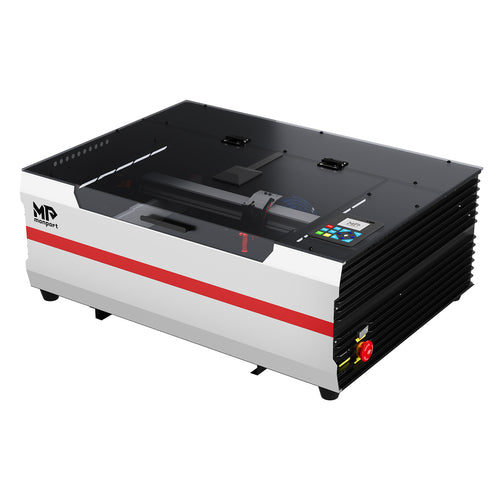
Brand New Monport 70W Desktop CO2 Laser Engraver & Cutter(28" X 14") - MEGAS| Built-In Water Cooling, 8MP HD Camera, AutoFocus

The Basic Working Principle of a CO2 Laser Engraver
A CO2 laser engraver converts electrical energy into a highly concentrated beam of infrared light. Inside the laser tube is a gas mixture primarily composed of carbon dioxide, nitrogen, and helium. When electricity passes through the tube, the gas molecules become energized and generate laser radiation at a wavelength of approximately 10.6 micrometers.
This invisible infrared beam carries a large amount of energy. Once focused onto a small point, the beam produces intense heat that can vaporize, burn, melt, or mark materials depending on the settings used.
The basic process follows these steps:
- Electricity energizes the gas mixture inside the laser tube.
- The tube generates an infrared laser beam.
- Mirrors guide the beam through the machine.
- A focusing lens concentrates the beam.
- The beam interacts with the material surface.
- Software controls movement, speed, and power output.

Components of a CO2 Laser Engraver
Several key components work together to produce accurate engraving and cutting results.
| Component | Function |
|---|---|
| CO2 Laser Tube | Generates the laser beam |
| Power Supply | Provides electrical energy to the laser tube |
| Mirrors | Direct the beam toward the laser head |
| Focusing Lens | Concentrates the beam into a small spot |
| Laser Head | Delivers the beam onto the material |
| Motion System | Moves the laser head across the work area |
| Controller Board | Executes software instructions |
| Cooling System | Maintains safe laser tube temperature |
| Air Assist System | Removes smoke and debris during processing |
| Exhaust System | Extracts fumes from the workspace |
Machines such as the Monport MEGAS integrate many of these systems into a compact desktop design to improve productivity and ease of use.

How the Laser Beam Travels Inside the Machine
Unlike a cutting blade, the laser beam never physically touches the material. After being generated inside the laser tube, the beam travels through a carefully aligned optical path.
The beam first reflects off a series of mirrors mounted throughout the machine. These mirrors redirect the laser toward the moving laser head while maintaining beam quality. The final lens inside the laser head concentrates the beam into an extremely small focal point.
Because the beam is focused into such a tiny area, the energy density becomes high enough to rapidly heat the material. This concentrated energy is what allows the machine to engrave fine details or cut through materials efficiently.

How the Laser Engraves or Cuts Materials
The difference between engraving and cutting comes down to how much energy is delivered to the material.
Engraving
During engraving, the laser removes only a portion of the material surface. The beam creates marks, textures, patterns, images, or text without cutting all the way through.
Common engraving applications include:
- Logos
- Serial numbers
- Photographs
- Personalized gifts
- Decorative artwork
Cutting
During cutting, the laser delivers enough energy to completely penetrate the material thickness along a predefined path.
Common cutting applications include:
- Signs
- Product components
- Packaging prototypes
- Acrylic displays
- Decorative panels
| Process | Purpose | Example Applications |
|---|---|---|
| Engraving | Surface marking | Photos, logos, text |
| Cutting | Material separation | Signs, shapes, parts |
| Scoring | Light surface lines | Fold guides, markings |
How a CO2 Laser Creates the Cutting Beam
The cutting beam originates inside the CO2 laser tube. As electrical energy excites the gas mixture, photons are generated and amplified through a process known as stimulated emission.
The resulting infrared beam exits the tube and travels through the optical system before reaching the focusing lens. Once focused, the beam can reach temperatures high enough to instantly vaporize or melt material in its path.
Higher-powered machines can generally process thicker materials and achieve faster cutting speeds. For example, a 70W CO2 laser offers significantly more cutting capability than entry-level desktop systems while still maintaining engraving precision.

How Software Controls a CO2 Laser Engraver
A CO2 laser engraver relies on software to convert digital designs into machine movements.
The workflow typically involves:
- Creating or importing artwork.
- Assigning engraving or cutting settings.
- Sending the file to the machine controller.
- Executing the job automatically.
Software determines:
- Laser power
- Travel speed
- Engraving resolution
- Cutting paths
- Processing order
Modern machines often support camera-assisted positioning, autofocus functions, material presets, and batch-processing features that simplify production workflows.
Why Focus and Air Assist Matter
Laser power alone does not determine engraving quality.
Proper Focus
The laser beam must be focused at the correct distance from the material. If the focus is too high or too low, the beam spreads out and loses cutting efficiency.
Accurate focus helps:
- Improve detail quality
- Produce cleaner cuts
- Increase cutting speed
- Reduce material waste
Air Assist
Air assist directs a continuous stream of air toward the cutting area.
Benefits include:
- Removing smoke and debris
- Reducing burn marks
- Improving edge quality
- Protecting the lens
- Reducing heat buildup
Together, proper focus and air assist significantly improve overall engraving and cutting performance.

What Materials Can a CO2 Laser Engraver Process?
CO2 lasers are particularly effective on non-metal materials.
Common compatible materials include:
- Wood
- Plywood
- MDF
- Acrylic
- Leather
- Paper
- Cardboard
- Cork
- Rubber
- Fabric
- Glass (engraving)
- Marble and stone (engraving)
Applications include:
- Sign making
- Personalized gifts
- Home décor
- Packaging prototypes
- Educational projects
- Product customization
Always verify material compatibility before processing, as some materials can release hazardous fumes when exposed to laser energy.
What Should Buyers Look For?
When comparing CO2 laser engraver manufacturers, consider more than just wattage.
Key factors include:
- Laser power
- Working area size
- Cooling performance
- Air assist capability
- Autofocus features
- Camera positioning systems
- Software compatibility
- Batch production tools
- Ease of maintenance
- Technical support
A well-rounded machine often provides greater long-term value than one that simply offers higher power.
Key Takeaways
A CO2 laser engraver works by generating an infrared laser beam inside a gas-filled tube, directing the beam through mirrors and lenses, and focusing it onto a material surface. Software controls the beam's movement, speed, and power, allowing the machine to engrave detailed designs or cut precise shapes.
Understanding the laser tube, optical path, software controls, focus system, and air assist technology can help buyers evaluate machines more effectively and select equipment that matches their production goals.
For SEO, this revised structure naturally targets the topic without repeatedly forcing the exact-match keyword, while covering the broader search intent users have when learning how CO2 laser engravers work.
FAQ
Is a CO2 laser good for small businesses?
Yes. A properly sized CO2 laser can handle personalized products, signs, craft items, and small production batches.
Can a 70W CO2 laser cut thick materials?
The MEGAS is designed for demanding cutting applications and can cut materials such as acrylic and basswood with suitable settings. Actual results depend on material type, thickness, focus, speed, and power.
Do I need to understand laser technology before buying?
No. Understanding the basics helps, but features such as autofocus, camera positioning, preset material parameters, and beginner-friendly software can simplify the learning process.

Choose a Machine Built for Your Next Stage
If your current laser is slowing down your workflow, limiting project size, or making batch orders difficult, upgrading can give you more room to produce and grow.
The Monport MEGAS 70W Desktop CO2 Laser Engraver & Cutter brings power, precision, automation, and production-focused features into one desktop system. Instead of choosing a machine only for today's projects, consider what you want to produce as your business grows.