Engraving glassware with conventional CO2 or diode laser technology can present challenges, including chipped edges, uneven textures, and surface micro-fractures. For personalized drinkware businesses, artisanal studios, and producers of crystal awards, consistent decorative marking is an important quality consideration.
Different glass formulations respond differently to laser energy. Ultraviolet (UV) laser technology, particularly systems operating at 355 nm, provides an alternative approach to precision surface marking. Its shorter wavelength can support fine detail on compatible glass materials, although results depend on composition, pulse characteristics, equipment design, and professional process validation.
This guide examines the science of UV glass marking, compares laser technologies, discusses 3W and 5W systems, reviews common glass and crystal materials, and explains how professional workshops can assess equipment, software, safety, and production economics.

The Optical Processing Conflict
Infrared CO2 laser (approximately 10,600 nm): Glass absorbs infrared energy strongly, which can generate localized heating and thermal stress.
Ultraviolet DPSS laser (355 nm): Shorter-wavelength photons can contribute to localized material modification through a mixture of photochemical and thermal mechanisms, depending on the glass and laser system.
Neither technology guarantees a completely crack-free finish. Professional evaluation of the finished surface is especially important for fragile, thin-walled, or valuable glassware.
1. The Physics of Cold Marking: Why UV Lasers Can Reduce Glass Engraving Defects

Photochemical Ablation vs. Thermal Stress: What Happens to Silica?
Glass contains a network of silicon–oxygen bonds. The original draft describes the bond energy of Si–O as approximately 4.77 eV, compared with about 0.12 eV for an infrared CO2 photon and 3.49 eV for a 355 nm ultraviolet photon. These figures illustrate why wavelength matters, but they do not by themselves establish the dominant glass-removal mechanism or guarantee a particular surface finish.
Infrared CO2 processing generally involves significant optical absorption and heating near the glass surface. Temperature gradients, cooling behavior, pre-existing flaws, and glass formulation all influence the possibility of chipping or cracking.
UV laser processing can concentrate energy into fine features and may reduce the extent of visible thermal damage under appropriately validated professional conditions. However, 355 nm nanosecond systems are not perfectly non-thermal: local heating and micro-cracking can still occur.
Photon Energy and Material Response
| Reference | Approximate energy | Interpretation |
|---|---|---|
| CO2 photon near 10,600 nm | 0.12 eV | Infrared absorption can generate strong thermal effects. |
| 355 nm UV photon | 3.49 eV | Higher-energy photon; material response varies by composition. |
| Si–O bond reference energy | Approximately 4.77 eV | Illustrative molecular bond energy; not a standalone engraving threshold. |
Heat-Affected Zones and Surface Quality
The original comparison emphasizes the possibility of a fine satin-frost finish with UV marking and a rougher finish after conventional thermal engraving. These are potential outcomes, not guaranteed results. A credible quality assessment should inspect edge definition, surface texture, visible defects, and material integrity rather than treating a particular wavelength as proof of zero damage.
2. Technology Face-Off: UV vs. CO2 vs. Fiber vs. Diode on Glass
Although all four technologies are associated with laser marking, they do not interact with clear glass in the same way. For commercial applications, equipment selection should focus on demonstrated compatibility and finished-piece quality.

The Masking Dilemma: How Surface Preparation Affects Labor
Some conventional glass-marking workflows use auxiliary coatings or other preparation materials. Preparing and cleaning each blank can increase handling time and add quality-control steps. The source draft proposes substantial labor savings from eliminating these stages; however, its quoted time savings and breakage percentages are illustrative claims, not substantiated production-test results.
Where a qualified UV process can mark clean glass without added coatings, fewer preparation stages may benefit a workshop. Actual time savings should be measured against the workshop's own materials, inspection standards, and production volume.
Comprehensive Technology Comparison
| Evaluation factor | 355 nm UV | CO2 | 1064 nm fiber | Blue diode |
|---|---|---|---|---|
| Typical interaction with clear glass | Material-dependent fine surface modification | Strong absorption and localized heating | Often low direct absorption in clear glass | Often limited direct absorption in clear glass |
| Common equipment format | Galvo marking systems | Gantry or marking systems | Galvo marking systems | Desktop gantry systems |
| Surface preparation | May not require additional coating for some validated materials | Depends on material and process | Specialized treatments may be needed | Specialized treatments may be needed |
| Finish considerations | Fine detail is possible; inspect for micro-defects | Thermal stress and chipping require evaluation | Generally not a first choice for untreated clear glass | Results vary strongly with material and coating |
| Best basis for purchasing | Samples of the intended glass or crystal | Verified finished-piece quality | Approved substrate compatibility | Approved substrate compatibility |
Engineering consideration: Clear glass and reflective surfaces can create optical and process hazards. Only suitably qualified personnel should assess machine compatibility and work within an appropriate enclosed, professionally controlled laser environment.
3. 3W vs. 5W UV Lasers: Wattage Selection for Small Businesses and Artisans

Choosing between a 3W and 5W UV laser involves more than comparing rated output power. Production volume, image size, design complexity, material response, optical quality, maintenance requirements, and total ownership cost all matter.
Wattage Selection Guide
| Aspect | 3W UV systems | 5W UV systems |
|---|---|---|
| Potential applications | Small personalized designs and detailed decorative projects | Broader production demands and larger filled designs |
| Purchase considerations | Initial cost, optics, software, and material samples | Additional output capacity and actual production throughput |
| Precision | Depends on optical design and beam quality, not power alone | Depends on optical design and beam quality, not power alone |
| Evidence to request | Documented samples on intended glassware | Documented samples and realistic cycle-time comparisons |
When a 3W UV Laser May Be a Better Fit
A lower-power UV system may suit a specialist workshop concentrating on small monograms, detailed decorative patterns, or limited custom runs. The source text emphasizes fine beam quality and initial capital efficiency. In practice, the actual performance depends on the exact laser source, optical field, and finished-product requirements.
When a 5W UV Laser May Be Worth Evaluating
Growing businesses producing denser graphics or larger order volumes may wish to compare a 5W system with lower-power models. Additional rated power can create more production flexibility, but it does not independently establish faster cycle times or an identical surface finish. The original draft's specific percentage improvements require controlled, model-specific evidence before publication.
4. Material Mastery: Soda-Lime, Borosilicate, Optical K9, and Lead Crystal
Transparent materials are not interchangeable. Composition, thermal expansion, inclusions, coatings, and existing mechanical stress influence how a particular piece reacts to engraving.

Everyday Glassware: Soda-Lime vs. Heat-Resistant Borosilicate
Soda-Lime Glass
Soda-lime glass is widely used for drinking glasses, bottles, jars, and other everyday products. It typically contains silica along with soda and lime. Commercial formulations vary, and their response to localized energy must be evaluated for the specific item.
Borosilicate Glass
Borosilicate glass includes boron compounds and is known for relatively low thermal expansion compared with ordinary soda-lime compositions. That characteristic does not guarantee a particular engraving result: different borosilicate products and manufacturing processes still require individual assessment.
Special Consideration: Tempered Glass
Tempered glass contains an engineered stress distribution. Surface modification may affect its integrity, so it should not be presumed suitable for decorative laser engraving without explicit manufacturer approval and a qualified engineering assessment.
Premium Crystal Engraving: K9 Optical Crystal vs. Lead Crystal
K9 Optical Crystal
K9 is a crown-glass family used in optical and decorative applications, including some awards and display objects. Consistent transparency and polished surfaces can be attractive for customized presentation pieces, although exact glass composition and marking behavior differ by supplier.
Lead Crystal
Lead crystal incorporates lead oxide in selected formulations and is valued for its optical appearance. Fine stemware can be delicate and commercially valuable. The draft's categorical assertion that UV processing is always safe for lead crystal is not supported by the uploaded material; compatibility should be verified with the item manufacturer and a qualified specialist.
Material Selection Overview
| Material | Common uses | Key consideration |
|---|---|---|
| Soda-lime glass | Standard drinkware, jars and bottles | Surface defects and thermal response |
| Borosilicate glass | Specialty drinkware and laboratory glass | Formulation and design-specific testing |
| K9 optical crystal | Awards and decorative blocks | Surface marking versus internal engraving |
| Lead crystal | Luxury drinkware and decorative pieces | Delicacy, composition and manufacturer restrictions |
| Tempered glass | Selected household and architectural products | Engineered internal stress and suitability concerns |
Can UV Lasers Perform 3D Subsurface Crystal Engraving (SSLE)?
Decorative surface etching and 3D subsurface crystal engraving are different applications. Subsurface images generally require purpose-built optics, pulse regimes, positioning systems, and materials. A standard desktop UV surface marker should not be assumed to provide the same capabilities as a dedicated subsurface engraving system.
5. Best UV Laser Engraver for Glass and Crystal: Hardware Selection
When comparing a professional UV engraving system, buyers should evaluate the laser source, beam quality, scanhead performance, working field, controller compatibility, material demonstrations, and support services as a complete package.

Key Evaluation Criteria: Galvo Performance, Optics, and LightBurn Compatibility
- Galvo scanning architecture: Assess image quality, repeatability, serviceability, and real finished samples rather than maximum quoted speed alone.
- UV-compatible optical components: Confirm that the manufacturer's optical system is specified for its laser wavelength.
- Design software: Check model-specific controller and LightBurn compatibility, operating system support, and licensing terms.
- After-sales support: Compare warranty coverage, component availability, training, and documented service options.
Monport Integrated Desktop UV: A Product Category to Evaluate
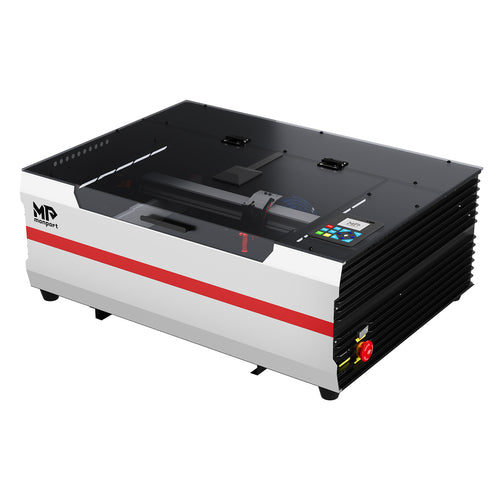
The source draft positions Monport integrated desktop UV systems as an option for gift studios and commercial marking workshops, highlighting compact galvo hardware, an integrated chassis, focusing assistance, controller connectivity, and optional rotary compatibility.
These capabilities should be checked against the current product specification for the exact Monport model and configuration. Do not assume every model includes internal cooling, a particular scan speed, a rotary connector, or native LightBurn support solely because those features appear in a general article.
Readers can begin with the official Monport website to review available UV laser engraving products and current specifications.
Why the Integrated Architecture Matters
An integrated benchtop design can reduce the footprint of a professional workstation when compared with some equipment layouts that use separate major components. The important purchase questions are whether the machine fits the workspace and whether cooling, servicing, extraction, and maintenance remain practical.
Workspace Safety and Fume Extraction
Professional UV marking equipment can present serious hazards from invisible radiation, reflections, particles, and fumes. A suitable engineered enclosure, professionally selected protective measures, and effective extraction are essential. Machine installation and operation should be handled by trained adults in accordance with manufacturer requirements and applicable workplace standards.
6. Rotary Compatibility and Cylindrical Glassware: Wine Glasses, Flutes, and Bottles
Marking curved or tapered objects presents additional challenges compared with flat workpieces. The physical shape of a wine glass, bottle, or flute affects positioning, design geometry, and the consistency of the finished mark.

Chuck Rotary vs. Roller Rotary: What Should a Workshop Evaluate?
Roller and chuck attachments use different approaches to accommodate cylindrical objects. Suitability depends on the size and strength of the item, its shape, and the approved capabilities of the machine and fixture.
Fragile glassware should never be treated like solid metal stock. Professional operators need to assess stability, contact stresses, and the risk of breakage using manufacturer-approved systems.
Conical Taper and Design Distortion
A tapered tumbler or flute has a changing diameter, which can affect the visual proportions of artwork transferred onto the surface. Design distortion should be evaluated in the planning and quality-check stages; a cylindrical setup that works for one glass shape may not suit another.
Focal Falloff and Wide Designs
Curved surfaces extend away from the nominal flat focal plane. This can make the appearance of wide designs inconsistent if the equipment and professional workflow are not appropriate for the product geometry.
Some compatible laser software offers features for segmenting or coordinating cylindrical marks. Availability depends on the machine controller, attachment, software version, and validated production process.
7. LightBurn Compatibility, Quality Validation, and Post-Processing
Good glass marking requires more than a software preset. Machine configuration, exact glass chemistry, artwork size, and the finished-product quality standard all affect the result.
Understanding Laser Parameters
Professional test records commonly document laser power, marking speed, pulse frequency, line spacing, and hatch pattern. These variables interact, and no universal settings apply to every glass type or laser source.
The uploaded draft includes numerical operating tables described as “verified” but provides no identifiable test reports, precise machine models, or independent validation. Those numbers should not be published as ready-to-use settings without suitable supporting evidence from qualified technical specialists.
Recommended Quality-Control Documentation
| Record | What to document |
|---|---|
| Glass substrate | Verified material type, supplier, and product model |
| Machine | Exact laser model, optics, and software configuration |
| Artwork | Dimensions and visual complexity |
| Approved process | Qualified operator's documented process reference |
| Finished appearance | Legibility, frost uniformity, and edge definition |
| Quality and safety | Defect inspection, compliance, and acceptance outcome |
Post-Marking Inspection and Cleaning
Glass marking can leave loose particles or surface residues. A professional finishing plan should include appropriate inspection and cleaning methods approved for the specific glass product. Avoid making claims about dishwasher resistance, food-contact suitability, or the durability of the mark without supporting testing.
Frequently Asked Questions (FAQ)
Can a UV laser engrave completely through glass or cut it?
Most desktop UV galvo marking systems are intended for marking rather than general-purpose glass-sheet cutting. Dedicated industrial glass-cutting equipment is a separate product category.
Do UV glass marking systems always need surface coatings?
Not necessarily. Some validated UV applications can mark suitable glass directly, but requirements depend on the material and the machine.
Why can CO2 and UV engraving produce different glass finishes?
Their wavelengths interact differently with glass. CO2 processing often generates pronounced localized heating; UV systems may offer fine feature control. Neither technology guarantees a particular texture or defect-free result.
Is a 3W UV laser sufficient for commercial drinkware projects?
A 3W system may meet the needs of certain small-format marking projects, but commercial suitability should be determined through qualified material samples, realistic throughput estimates, and total ownership costs.
Is UV laser engraving safe for expensive lead crystal wine glasses?
No engraving process should be regarded as universally safe for valuable or fragile crystal. Material composition, existing flaws, and manufacturer restrictions must be assessed before professional processing is considered.
Conclusion: Elevating Your Glass Engraving Business
For custom gift shops, decorators, and manufacturers of personalized awards, UV laser technology can be a useful category to evaluate for fine surface marking on compatible glass and crystal. The strongest business case depends on verifiable finished-product quality, suitable workspace infrastructure, and documented production economics.
When comparing 3W and 5W options, consider real workload, materials, optical quality, support, and validated demonstrations. Avoid basing the choice solely on wattage, advertised maximum speed, or unsupported claims of guaranteed crack-free results.
Professional workshops exploring this category can review Monport's available laser engraving equipment and request current model specifications and material evidence before making a purchasing decision.