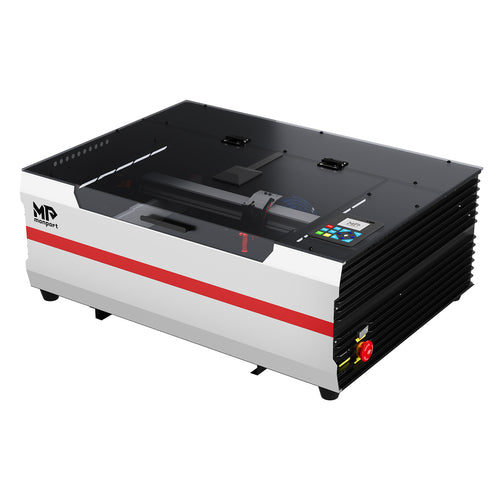
If you've been shopping for a marking machine and keep running into the term "cold laser," you've already brushed up against UV laser technology. A UV laser is a type of laser that emits light in the ultraviolet spectrum — typically around 355nm — and it marks materials through a photochemical reaction instead of heat. That difference is why a 10W UV laser engraver can etch glass, ceramics, and coated plastics without cracking, melting, or leaving a burnt edge behind. In this guide, we'll break down how UV lasers actually work, where they outperform CO2, fiber, and diode lasers, and which projects make the most sense for a UV laser engraving machine.


What Is a UV Laser?
A UV laser produces light at a much shorter wavelength than the lasers most people are familiar with. For comparison:
CO2 lasers: 10,600nm (infrared)
Fiber lasers: 1,064nm (near-infrared)
UV lasers: around 355nm (ultraviolet)
Because UV light sits at the short end of the spectrum, each photon carries more energy per pulse. That energy is enough to break molecular bonds directly, a process engineers call a "cold" or "photochemical" reaction. Instead of burning through a surface with heat, the laser essentially vaporizes a microscopically thin layer of material, leaving barely any heat-affected zone behind.
This is the core reason a UV laser can do things a CO2 or fiber laser can't: it marks with almost no thermal stress, so fragile or heat-sensitive materials come out clean instead of scorched.

Why the Short Wavelength Matters
The shorter wavelength also focuses to a much smaller spot. On a 10W UV laser engraver like the Monport GM 10W, the beam spot size is just 0.0019mm — roughly 1/40th the spot size of a typical fiber laser. A smaller spot means the laser can resolve finer detail, which is why UV systems are often rated for engraving resolutions up to 16K.
How Does a UV Laser Engraver Work?
A UV laser engraving machine follows the same general path as other laser marking systems, but with a few key differences in the components:
- Laser source: Generates the 355nm UV beam.
- Galvanometer scanner: Steers the beam across the work surface at high speed. On the Monport GM 10W, this galvanometer uses an industrial-grade all-metal housing and can scan at up to 15,000mm/s.
- Cooling system: Because UV laser modules are sensitive to temperature swings, a water chiller keeps the laser at a stable operating temperature so output stays consistent during long runs.
- Focusing lens: Concentrates the beam down to its ultra-fine spot before it reaches the material.
- Control software: Handles the design file, sets marking parameters (speed, power, frequency), and sends instructions to the galvanometer.
When the machine fires, the UV beam interacts with the surface at a molecular level rather than a thermal one. This is why materials like glass and certain plastics — which would crack or discolor under a CO2 or fiber laser — come out with crisp, permanent markings.

UV Laser vs. CO2 vs. Fiber Laser
Choosing between laser types comes down to what you're marking and how deep or fast you need the result. Here's how they stack up:
| Feature | UV Laser | Fiber Laser | CO2 Laser |
| Wavelength | ~355nm | ~1,064nm | ~10,600nm |
| Best for | Glass, ceramics, plastics, coated metals | Bare and coated metals | Wood, acrylic, leather, non-metals |
| Heat-affected zone | Minimal (cold marking) | Moderate | Moderate to high |
| Typical spot size | ~0.0019mm | 0.03–0.1mm | Larger, less precise for micro-marking |
| Ideal use case | Delicate, heat-sensitive materials, micro-marking | Deep metal engraving, structural marking | Cutting and engraving organic materials |
No single laser type wins across every material — that's why many production shops run a UV, fiber, and CO2 machine side by side rather than trying to make one system do everything. For a deeper side-by-side breakdown, see our guide on Fiber Laser vs UV Laser: Which Marking Technology Is Right for Your Business.

Benefits of UV Laser Engraving
1. Virtually No Heat Damage
Because the marking process is photochemical rather than thermal, a UV laser engraving machine avoids the warping, discoloration, and micro-cracking that heat-based lasers can cause on sensitive substrates. This is the single biggest reason manufacturers choose UV over fiber or CO2 for glass, thin plastics, and coated components.
2. Exceptional Precision
With a spot size measured in thousandths of a millimeter, UV lasers are suited to micro-marking work — think serial numbers on medical devices, fine detail on jewelry, or dense data matrix codes on small electronic components. The Monport GM 10W, for example, is built for ±0.001mm positioning accuracy, which matters when you're marking components that leave no room for drift.
3. Broader Material Compatibility
A 10W UV laser engraver can process an unusually wide range of substrates — plastics, glass, ceramics, ceramics-coated metals, and even some leather and coated packaging — without swapping settings dramatically between jobs. This flexibility is valuable for shops that handle mixed production runs rather than a single material type.

4. Clean, Odor-Free Marking
Because there's minimal burning involved, UV laser marking produces little to no smoke and almost no odor compared to CO2 engraving on similar-density materials. That makes it a more comfortable process to run in enclosed production environments, especially with proper ventilation still in place.
5. Long Operating Life
A well-maintained UV laser source typically runs for 10,000–20,000 hours before performance starts to decline meaningfully, depending on power level, cooling, and upkeep. Regular lens cleaning and stable cooling (which the built-in water chiller handles automatically) are the main factors that keep output consistent over the machine's lifespan.
What Can You Engrave With a UV Laser Engraving Machine?
UV laser systems are commonly used across these industries and applications:
- Electronics manufacturing: Marking PCBs, connectors, and small components without heat stress to surrounding parts
- Medical devices: Permanent, biocompatible-safe marking on plastic and glass components
- Glassware and crystal: Logos, text, and fine artwork on drinkware, awards, and decorative glass
- Jewelry: Fine detail marking on delicate metals and gemstone settings
- Packaging: Date codes, batch numbers, and branding on plastic and coated packaging materials
- Ceramics: Clean, high-contrast marking without glaze damage

Choosing Between a 6W and 10W UV Laser
Power level changes what a UV system is best suited for. A 6W UV laser is generally more compact and cost-effective, and it's well suited to fine-detail work like jewelry or microelectronics where speed matters less than precision. A 10W UV laser engraver adds more power headroom, which translates to faster processing and higher-contrast marking — a better fit for production environments where throughput matters. If your work is mostly one-off detail pieces, 6W may be all you need; if you're running batch orders or industrial marking, the extra power of a 10W system pays off in reduced cycle time. You can compare both side by side on the UV Laser Engraver collection page.
See It in Action: UV Laser Engraving Videos
Reading about cold marking only goes so far — seeing the beam in action on glass and crystal makes the "zero heat damage" claim much easier to picture. Two videos worth watching:
A full walkthrough of the Monport UV10W, covering unboxing, setup, and sample marking runs for small business production.
A short clip showing UV laser subsurface engraving inside a solid crystal block, a good example of the precision detailed earlier in this guide.
Frequently Asked Questions
1.Is a UV laser safe for glass?
Yes. Because UV lasers use a very small heat-affected zone, they're well suited to delicate materials like glass and fire-rated glass, producing fine, precise markings with minimal risk of cracking.
2.How is UV laser marking different from laser cutting?
UV laser engravers are built for surface marking and fine engraving rather than cutting through thick material. The process removes a microscopically thin layer or alters the surface color/texture, which is why it's used for logos, text, and codes rather than structural cutting.
3.Can a UV laser engraving machine mark metal?
Yes, particularly coated or anodized metals, where the UV laser can create high-contrast marks without disturbing the base metal underneath. For deep engraving into bare metal, a fiber laser is typically the better tool for the job.
4.Do I need a chiller for a UV laser engraver?
Yes. UV laser modules are sensitive to temperature fluctuations, so a water chiller is used to keep the laser at a stable operating temperature, which helps maintain consistent output and extends the laser's service life. It's also worth pairing your machine with the right UV laser protective glasses to keep operators safe during use.
5.How long does a UV laser last?
A quality UV laser typically runs 10,000–20,000 hours depending on power, cooling, and maintenance. Keeping the optics clean and ensuring good ventilation helps performance stay stable over time.
Conclusion
UV laser technology solves a problem that CO2 and fiber lasers can't: marking delicate, heat-sensitive, or highly reflective materials without damaging them. Whether you're producing medical components, glassware, jewelry, or coded packaging, a UV laser engraving machine gives you the precision and material range that production work demands. If your shop needs speed on top of that precision, a 10W UV laser engraver like the Monport GM 10W is built to keep up with higher-volume runs while still holding micron-level accuracy.
Ready to see what UV laser marking can do for your production line?
Explore the Monport UV Laser Engraver lineup, check out the Monport GM 10W UV Laser Engraver directly, and use code BESTMP10 for 8% OFF your order.