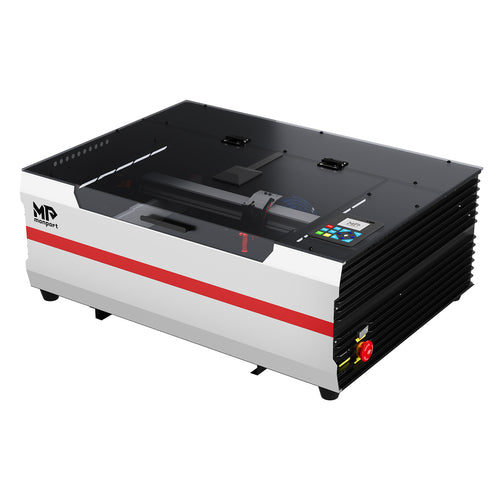
When heavy-duty industrial components undergo precision drafting, custom machining, and reverse engineering, tracking those custom parts across their entire lifecycle becomes a crucial challenge. Industrial machine shops like Mechanical Analysis & Repair (MarTech) specialize in solving complex engineering problems, rebuilding obsolete components, and delivering high-precision machining for power generation, manufacturing, and aerospace sectors. In environments where heavy machinery, valves, and custom assemblies face intense operational wear, standard printed tags fall short. Using a reliable fiber laser engraver for metal ensures that custom-machined parts, reverse-engineered components, and safety nameplates retain permanent, ultra-precise identification throughout decades of rigorous service.
For precision machine shops utilizing tools like 3D modeling, PMI guns, and CNC machining, component identification must match the exact tolerances of the engineering itself. Subcontractors and plant operators cannot afford to lose critical serial numbers, material specs, or dynamic barcodes when parts are exposed to high heat, friction, or harsh solvents. By deploying a high-performance GM 60Pro Fiber Laser, industrial facilities can seamlessly engrave high-contrast Data Matrix codes, metallurgical callouts, and serial tags onto stainless steel, titanium, brass, and anodized aluminum. These laser-etched markings withstand severe industrial conditions without degrading or fading over time.
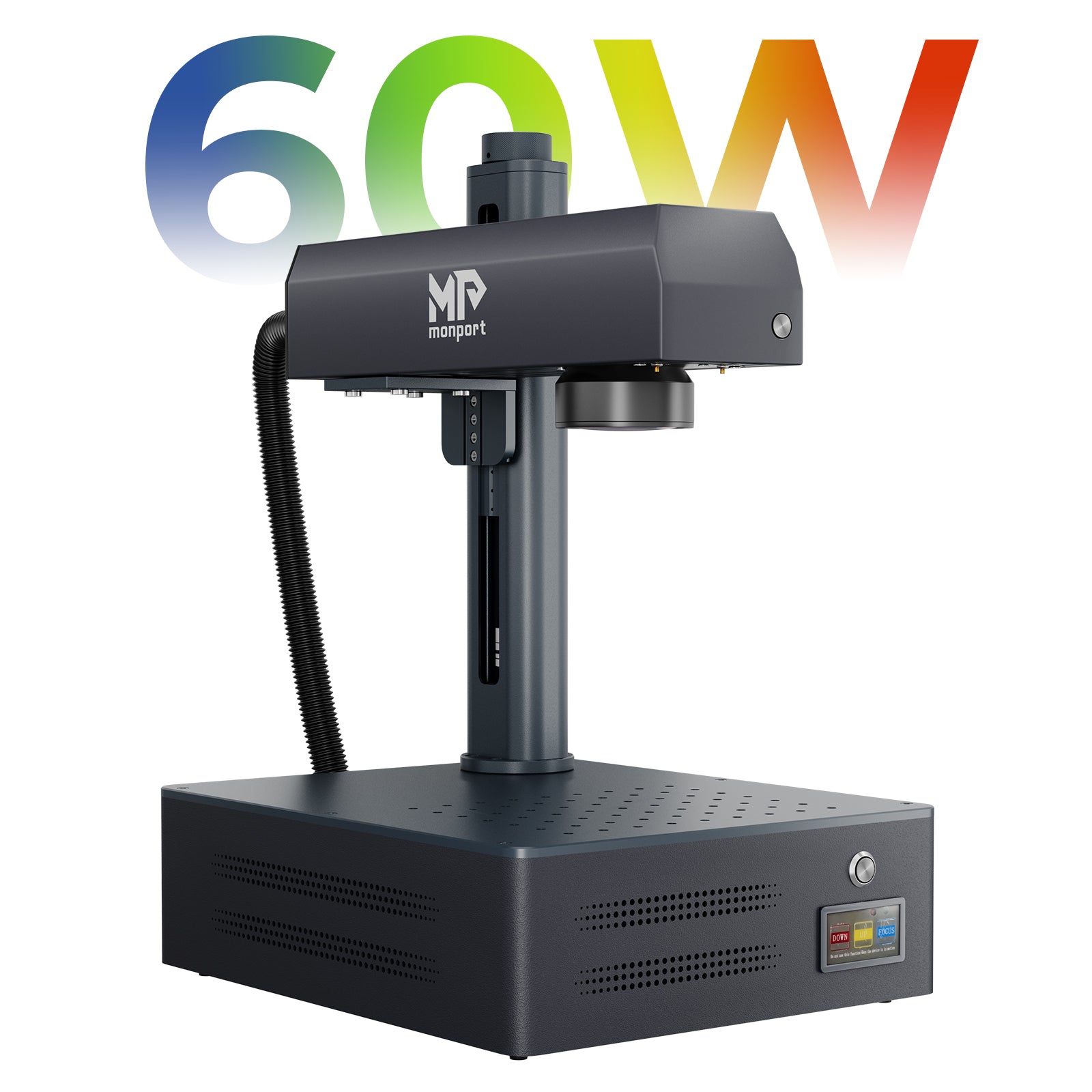

Integrating direct laser marking into your shop's machining and prototyping workflow bridges the gap between precision fabrication and long-term asset traceability. Whether reverse engineering worn machinery or producing custom OEM production runs, utilizing a dedicated fiber laser engraver for metal helps maintain quality control and simplifies regulatory compliance. The exceptional speed and accuracy of the GM 60Pro Fiber Laser make it an indispensable asset for modern industrial machine shops focused on high-durability nameplate creation and part identification.
Why Custom Machining and Drafting Demand Permanent Nameplates

Precision engineering relies on exact specifications, from material composition data down to structural tolerance limits. Equipment nameplates and component tags communicate these vital parameters to site technicians and maintenance teams in the field.
When environmental factors or heavy wear cause identification tags to become unreadable, operators face severe maintenance delays, safety compliance risks, and difficulty sourcing exact replacement parts. Traditional ink printing or light surface etching degrades rapidly when subjected to industrial degreasers, hydraulic fluids, and thermal cycling.
Direct fiber laser engraving creates permanent surface alterations or deep subsurface annealing. This guarantees absolute asset traceability and clear identification across the entire operational lifespan of custom-machined equipment.
Key Identification Applications for Industrial Machining Operations
High-Density Barcodes and Reverse-Engineered Part Tracking
When reverse engineering obsolete parts or prototyping custom assemblies, tracking component iterations requires precision. Fiber lasers produce ultra-crisp 2D Data Matrix codes and serial identifiers that optical scanners read effortlessly.
Safety Ratings, Schematic Markings, and Valve Tags
High-pressure valves, electrical enclosures, and heavy industrial assemblies require permanent safety warnings and flow schematics. Laser engraving applies sharp micro-text and detailed technical diagrams directly onto rugged metal tags.
High-Contrast Annealing on Corrosion-Resistant Alloys
Utilizing MOPA laser technology allows operators to tune pulse parameters to achieve crisp, dark markings without scorching metal surfaces. This produces deep black lettering on stainless steel and titanium tags while preserving the material's structural integrity and corrosion resistance.
Technical Specifications: Monport GM 60W Pro Integrated JPT MOPA Fiber Laser Engraver
The Monport GM 60W Pro integrates industrial-grade marking power into a compact, benchtop design built for demanding production environments.
| Parameter | Specification Details |
| Product Dimensions | 400 x 330 x 620mm |
| Product Weight | 16.6kg |
| Laser Power | 60W |
| Laser Type | MOPA Fiber Laser |
| Wavelength | 1064nm |
| Frequency Range | 1-4000kHz |
| Pulse Width | 2-500 ns |
| Rated Voltage | 220V |
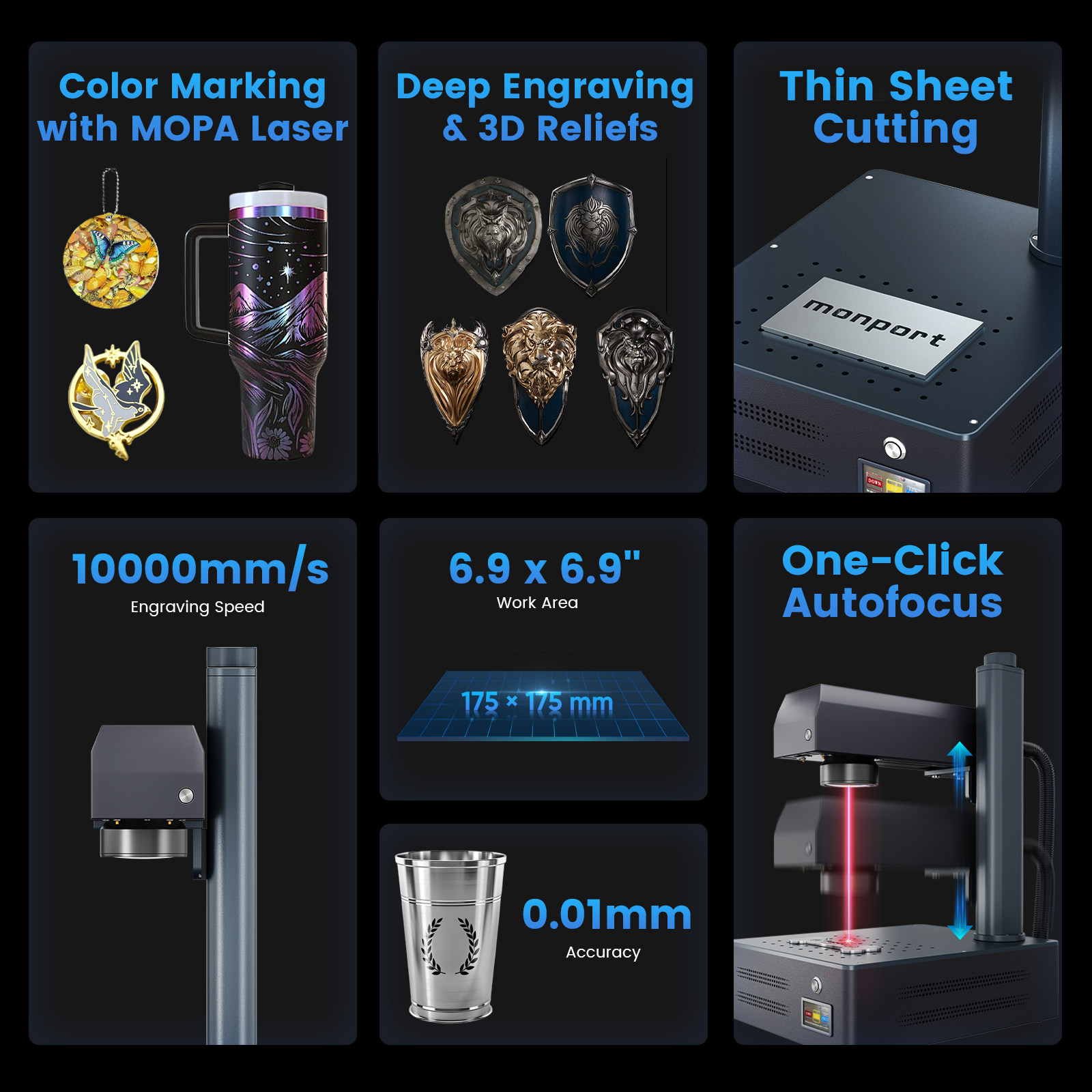
| Engraving Area | 6.9 x 6.9 in. (175x175mm) |
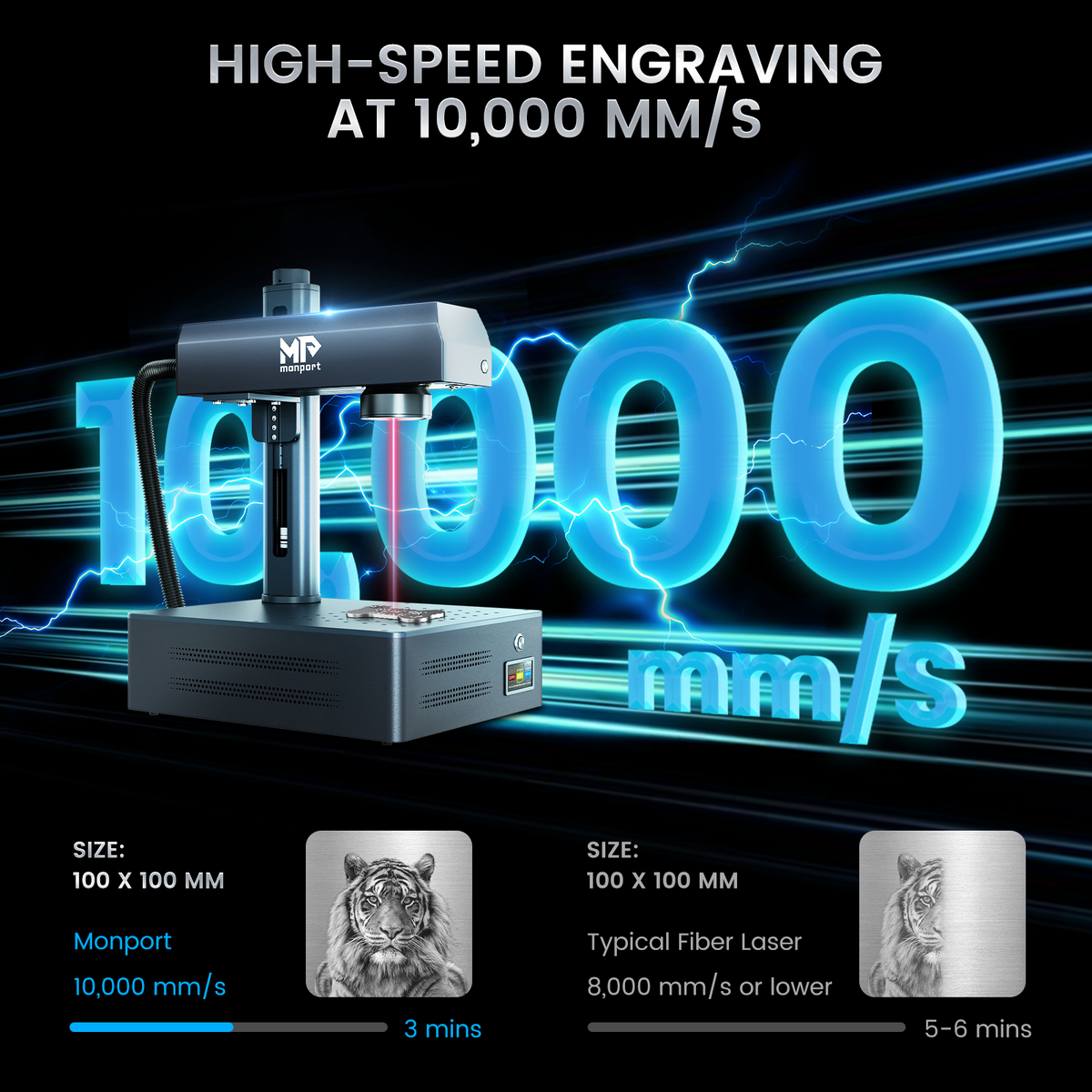
| Max. Engraving Speed | 10000mm/s (393.7 ips) |
| Engraving Accuracy | 0.01mm |
| Compatible Operating Systems | Windows / macOS |
| Compatible Software | BslAppSimple, LightBurn |
| Expected Service Life | 100,000 hr. |
Advanced Engineering Features of the Monport GM 60W Pro
One-Touch Autofocus Technology
Switching between varying plate thicknesses and custom-machined parts can slow down shop operations. The GM Pro Series comes equipped with a cutting-edge one-touch auto-focus feature, enabling faster and more precise engraving results with maximum convenience.
High-Speed Galvanometer and Custom Optics
The newly designed galvanometer system features high-quality silicon material reflectors, pushing the maximum speed to an impressive 10,000mm/s. Coupled with a custom F-theta field mirror, this advanced marking system ensures engraving accuracy down to 0.01mm.
Tuned Working Area Integrity
For the 60W Mopa fiber laser, the optimal working area is 175*175mm. Going beyond this size may lead to subpar engraving results or even distortion. Thanks to Monport's precise tuning, you can engrave at the edges with consistent power, ensuring no weak spots or loss of intensity.
Deep Engraving and 3D Relief Engraving
The higher the power, the greater the depth and detail you can achieve in your engravings. With enhanced power, the machine delivers superior deep engraving and 3D relief results, providing unmatched precision and depth for intricate designs.
Key Takeaways
-
Permanent laser marking eliminates the risk of lost serial tags, safety documentation, and part identification on custom-machined equipment.
-
MOPA fiber technology enables precise pulse control, creating high-contrast black markings on stainless steel and alloys without weakening corrosion resistance.
-
Delivering engraving speeds up to 10,000mm/s with 0.01mm accuracy, the GM 60Pro Fiber Laser efficiently handles high-volume tag and serial number runs.
-
Native cross-platform support for LightBurn on both Windows and macOS ensures seamless integration into existing CAD and drafting software workflows.
Conclusion
Industrial equipment identification demands complete permanence, sharp legibility, and high resistance to chemical and physical wear. Equipping your machine shop or repair facility with a powerful fiber laser engraver for metal ensures every component tag, safety badge, and machine plate stands up to the harshest industrial applications.
Incorporating a specialized unit like the GM 60Pro Fiber Laser delivers the exact speed, power, and high-detail accuracy needed to produce custom metal tags in-house. Relying on an advanced fiber laser engraver for metal enables engineering teams to maintain full quality control over asset tracking and component documentation.
The high-performance features of the GM 60Pro Fiber Laser provide modern machine shops with a complete marking solution for industrial parts and custom equipment nameplates. If you're ready to grow your business, Shop Now and use code BESTMP10 to enjoy 8% OFF your Monport purchase.
Frequently Asked Questions

Why is fiber laser engraving preferred over chemical etching for industrial equipment nameplates?
Fiber laser engraving creates permanent physical or chemical surface changes on metal, yielding highly durable markings that resist heat, solvents, and physical abrasion without using hazardous chemicals.
Which metals can the Monport GM 60W Pro engrave?
The system marks stainless steel, anodized aluminum, brass, copper, titanium, carbon steel, and various industrial alloys with 0.01mm professional accuracy.
How does MOPA technology benefit part traceability in machining?
MOPA lasers allow independent adjustments of pulse width and frequency, enabling clean black annealing on stainless steel and fine micro-text marking without thermal distortion.
Is the Monport GM 60W Pro compatible with LightBurn on macOS?
Yes, the Monport GM 60W Pro fully supports both macOS and Windows operating systems and works seamlessly with LightBurn and BslAppSimple software.
What maintenance is required for a 60W MOPA fiber laser engraver?
Fiber lasers are solid-state systems with no gas consumables or lamps, offering an expected service life of 100,000 hours with minimal routine focal lens cleaning.