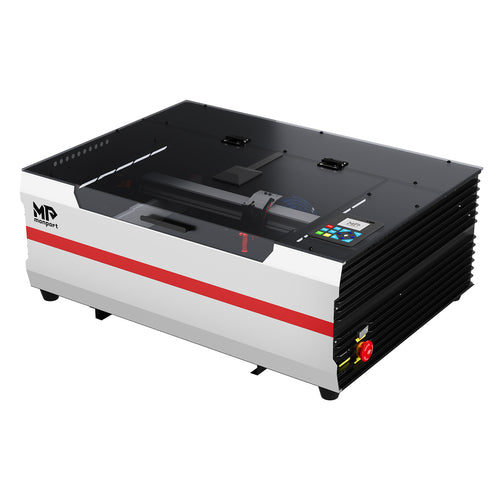
The best portable laser engraver is the machine that fits your materials, products, workspace, and travel routine as a complete system. A small housing alone does not make a laser practical to move. Extraction, cooling, a computer, fixtures, a rotary attachment, cables, approved materials, and protective packing may all travel with it.
For wood, paper, verified laser-safe leather, and many coated products, an enclosed diode laser can be an accessible mobile option. For clear acrylic and broader nonmetal cutting, a compact CO2 laser is usually more capable but harder to transport. For direct marking and engraving on many bare metals, a compact fiber or galvo laser is generally the more relevant category.
This guide focuses on U.S. small-business buyers and event operators. It compares equipment categories and buying criteria rather than presenting an untested model ranking. Product specifications, software support, certifications, prices, and venue rules can change, so confirm them with the current manufacturer documentation before buying or operating a machine.
Which Portable Laser Engraver Is Best? The Short Answer
Start with the job, not the wattage. The material, surface condition, product shape, and desired result should eliminate unsuitable laser types before you compare convenience features.

| Main business need | Best category to investigate first | Important limitation |
|---|---|---|
| Engraved wood, paper, approved leather, and coated products | Enclosed diode laser | Usually not the right choice for direct engraving on bare metal or cutting clear acrylic |
| Clear acrylic plus a broad range of suitable nonmetals | Compact enclosed CO2 laser | Cooling, optics, ducting, weight, and transport instructions can make frequent travel impractical |
| Bare-metal tags, tools, jewelry, machine parts, and serial marks | Compact fiber or galvo laser | Marking fields are often smaller, and the system is not a general-purpose nonmetal cutter |
| Regular metal and nonmetal personalization from one station | Enclosed dual-source system | Higher cost and weight may not be justified if one source is rarely used |
A business selling engraved wooden ornaments has different requirements from one marking stainless-steel identification plates. Neither should pay for capabilities that do not support its core products. Write down the exact products you intend to sell before opening a product comparison page.
How to Evaluate Whether a Laser Is Truly Portable
Terms such as portable, compact, and desktop are not interchangeable. A desktop machine may fit on a table and still be difficult to move safely. Use three practical mobility levels instead.

Ultra-compact
An ultra-compact system is intended for frequent movement and small jobs. It may suit names, logos, tags, or event personalization, but a small marking field, limited object clearance, and the need for stable positioning can restrict the product range. A compact laser source can still present serious optical and fume hazards; size does not determine laser classification.
Carryable desktop
A carryable desktop laser can be transported by one trained operator under that business's lifting policy or moved on a cart without specialist equipment. It is often a practical compromise for businesses that work mainly in a studio and attend occasional events.
Transportable workstation
A transportable workstation fits in a suitable vehicle and can be relocated, but regular setup and teardown may require two people, multiple cases, or a loading cart. Many enclosed CO2 machines and larger hybrid systems belong in this group. They can be excellent small-studio tools without being convenient weekly event machines.
Build a portability score from measured facts
Do not rely on one marketing label. Record the following information for every machine on your shortlist:
| Measure | What to record | Why it matters |
|---|---|---|
| Machine and packed dimensions | Operating footprint, shipping or case dimensions, lid clearance, and loading orientation | Determines table space, vehicle fit, storage, and access through doors |
| Complete travel weight | Laser, enclosure, extractor, cooling equipment, computer, rotary, fixtures, cables, stock, and cases | Shows what the operator must actually move |
| Number of cases | Every box, case, cart, and loose accessory required for a normal job | A light machine surrounded by separate equipment may be a poor mobile system |
| Setup and teardown time | Median time across at least three realistic trials | Reveals labor that product pages rarely show |
| Post-transport checks | Focus, alignment, lens, cooling, exhaust, framing, and test-mark requirements from the manual | Shows whether moving the machine creates recurring work |
| Site requirements | Voltage, continuous and startup load, exhaust route, internet dependency, noise, and table capacity | Determines whether the machine can operate at the intended location |
Set your own pass/fail limits before comparing brands. For example, decide whether the full kit must be moved by one person, whether setup must fit inside a venue's load-in window, and whether the workflow must remain functional without internet access. These are business requirements, not universal industry thresholds.
Choose the Laser Source Before the Machine
Laser power is meaningful only after the source is appropriate for the material and process. Two machines with similar wattage can behave very differently because wavelength, beam delivery, pulse behavior, optics, and material absorption differ.

Diode laser engravers
Compact diode lasers are commonly used for suitable wood, paper, cardboard, approved natural leather, some dark acrylic, and many painted, anodized, or coated surfaces. They are often lighter and simpler to move than CO2 systems.
A blue diode should not be treated as a substitute for a fiber laser. It may remove a coating from metal or create a mark with a compatible marking product, but that is a different process from direct metal engraving. Transparent or lightly colored materials can also respond differently from dark materials, so test the exact blank.
An open-frame diode may appear highly portable, but adding an appropriate enclosure, exhaust, base, and safety controls can change its footprint and travel weight. Evaluate the finished station.
CO2 laser engravers

CO2 lasers are versatile tools for suitable nonmetals, including many woods, acrylics, approved leather, glass surface engraving, and materials specifically sold as laser-safe engraving stock. Clear acrylic capability is a major reason businesses move from a blue diode to CO2.
The mobility tradeoff is substantial. A desktop CO2 system may contain sensitive optics, a glass tube, cooling components, exhaust ducting, and alignment-sensitive assemblies. Review the manual for transport orientation, temperature limits, draining or cooling procedures, and checks required after movement. A machine that moves twice a year has a different portability requirement from one loaded into a vehicle every weekend.
Businesses that primarily need acrylic and other nonmetal production can compare current Monport CO2 laser engravers by work area, object clearance, cooling, exhaust, power requirements, and installation instructions.
Fiber and MOPA fiber laser engravers

Fiber lasers are commonly evaluated for direct marking and engraving on many bare metals, including appropriate stainless steel, aluminum, brass, tools, tags, jewelry, and machine components. The exact result depends on the source, pulse settings, lens, alloy, surface condition, and process goal.
A conventional pulsed fiber laser may be suitable for high-contrast marking and material removal. A MOPA fiber source offers a wider adjustable pulse range, which can provide more process control for certain heat-sensitive marks, surface finishes, and color-marking applications. A MOPA label does not guarantee a specific color or finish; the exact metal and settings still require testing.
Galvo systems often process a relatively small field quickly. Changing the field lens can affect field size, spot characteristics, working distance, and focus behavior. For rings, bracelets, tumblers, or cylindrical parts, verify the rotary, usable diameter, object clearance, and fixture repeatability as one workflow.
Metal-focused businesses can compare Monport fiber laser engravers by source type, power, marking field, focus method, enclosure options, rotary compatibility, controller, and software.
Dual-source laser systems
A dual-source system can reduce the number of machines at a mobile booth when metal and nonmetal orders both occur regularly. Before paying for that convenience, compare it with two dedicated machines on total price, full packed weight, working area, source-change workflow, serviceability, and expected utilization.
Calculate how often each source will generate paid work. If 90 percent of orders use one source, a simpler dedicated machine may be easier to operate and support. A combined system also creates one point of failure for both product categories.
Portable Laser Engraver Category Comparison
| Category | Strongest fit | Mobility profile | Questions to verify |
|---|---|---|---|
| Open-frame diode | Budget studio projects using approved nonmetals and coated items | Light machine; enclosure and extraction add bulk | Which enclosure and exhaust are approved? What safety controls are included? |
| Enclosed diode | Small studios and repeatable craft products | Often easier to deploy as one controlled unit | What is the product classification? Are interlocks, exhaust, emergency stop, and offline operation documented? |
| Compact CO2 | Clear acrylic and broader nonmetal cutting or engraving | Usually vehicle-transportable rather than carry-anywhere | How should it be transported? What cooling, alignment, exhaust, and circuit requirements apply? |
| Compact fiber or galvo | Metal tags, tools, jewelry, tumblers, and serial marking | Small marking station, but enclosure, computer, rotary, and extraction still travel | Is the field large enough? Which lens and source are included? What fixtures and software are required? |
| Dual-source enclosed | Regular mixed-material personalization in limited space | One station replaces two, but cost and weight can rise | How are sources selected and focused? Will both sources earn enough revenue to justify the premium? |
Best Portable Laser Category by Business Use Case

Craft fairs and live personalization
Prioritize controlled access, repeatable jigs, simple customer proofs, offline job preparation, practical extraction, and a documented emergency stop. Laser cycle time is only one part of customer wait time. Spelling confirmation, payment, design approval, positioning, a test mark when needed, inspection, cooling, and packaging all affect throughput.
Use this formula during a rehearsal:
Estimated orders per hour = 60 ÷ total minutes per completed order
Measure total order time rather than using the machine's engraving time. Run several typical orders and use a conservative result. Keep the event menu narrow: a few approved products with proven files and fixtures are easier to operate than accepting unknown customer items.
Wood, approved leather, and small craft products
An enclosed diode can suit engraved keychains, patches, coasters, ornaments, and small signs when the materials are verified for laser use. If clear acrylic cutting or a wider suitable nonmetal range is central to the catalog, a compact CO2 system may justify the extra transport burden.
Natural materials vary. Wood species, grain, moisture, resin, finish, adhesive, leather tanning, dye, and coating can change the result. A settings file is a starting point, not proof that every batch will behave identically.
Metal tags, tools, jewelry, and tumblers
A compact fiber or MOPA fiber system is normally the category to investigate for direct work on many bare metals. Compare the source and lens with the mark you need: surface contrast, annealing where appropriate, coating removal, or material removal for depth.
Curved products can turn a fast laser into a slow service if loading is inconsistent. Test the rotary and fixture with the exact diameter, handle, taper, seam, or product geometry you plan to sell.
A small studio that moves only occasionally
Do not sacrifice useful work area or production capability simply to minimize weight. A transportable enclosed CO2 or fiber workstation may be the better investment when it operates in one studio most of the year and moves only for selected demonstrations.
Measure permanent floor or table space, lid movement, loading access, exhaust ducting, maintenance clearance, and accessory storage. The machine's listed width and depth do not describe the full operating footprint.
Calculate the Total Cost of a Mobile Laser Setup
The machine price is not the project budget. Build a worksheet before comparing offers:
Total initial setup cost = machine + required enclosure + extraction or filtration + cooling or air assist + rotary + computer + fixtures + electrical accessories + transport cases or cart + initial approved materials + training + applicable venue or insurance costs
Then estimate recurring operating cost:
Estimated cost per order = blank + packaging + consumables + allocated filter and maintenance cost + labor time + payment or venue fees + allocated equipment cost
Do not insert optimistic revenue assumptions simply to justify a purchase. Use your own selling price, realistic order time, event attendance, scrap rate, and expected utilization. Include the cost of downtime: replacement-part availability and technical-support response can matter more than a small difference in purchase price.
Cost items buyers commonly miss
- Replacement filters and the schedule for monitoring or changing them
- Rotary attachments, risers, field lenses, and product-specific fixtures
- A laptop, licensed software, cables, adapters, and offline backup files
- Protective packing, a loading cart, and a table rated for the full setup
- Test blanks, rejected pieces, masking, cleaning supplies, and packaging
- Maintenance parts, lens protection, cleaning, calibration, and service time
- Venue fees, insurance, staff training, barriers, signage, and approved fire equipment
- A backup plan when live production cannot continue
A heavier integrated machine may be easier to deploy than a light open-frame laser surrounded by separate equipment. Compare systems, not cartons.
Safety, Material Approval, and Venue Requirements
Portability does not reduce laser risk. The U.S. Food and Drug Administration classifies laser products according to their potential hazard. Review the label, classification, manual, enclosure, interlocks, viewing window, key control, emergency stop, and required protective measures for the specific finished product. Do not assume that an enclosure or compact housing makes every machine suitable for public operation. See the FDA's Laser Products and Instruments information as a starting point.
Create a material acceptance policy
Do not process an unidentified item at an event. Appearance alone cannot confirm material composition. Require a known substrate and coating, supplier documentation where needed, and approval under the laser and extraction manufacturers' instructions. Check the safety data sheet when available.
Use particular caution with synthetic leather, plastics, coated composites, adhesives, and products supplied by customers. If the composition cannot be verified, reject the job. “It looks like leather” or “another seller engraved it” is not an acceptable material identification method.
Plan extraction for the actual process
Laser processing can create smoke, particles, odors, and material-specific contaminants. A nearby window or small fan is not a universal control. Ask the extraction supplier to size the system for the laser, material, process, enclosure, duct length, and intended operating time. Document filter stages, replacement indicators, replacement cost, and the permitted exhaust route.
Never promise that filtration makes an unknown material safe. Source control begins with approved materials and processes.
Get written venue approval
Before advertising live engraving, ask the organizer or venue to confirm:
- whether laser processing is permitted;
- available voltage, circuit capacity, outlet location, and extension-cable rules;
- whether outdoor exhaust is allowed or an approved filtration system is required;
- fire-safety, supervision, barrier, noise, and public-access requirements;
- insurance or documentation requirements;
- load-in access, stairs, parking distance, and table capacity.
Wireless control does not mean battery-powered operation. If considering a portable power station, confirm that the equipment manufacturer permits it and that the supply can support the complete system's startup and continuous loads, including extraction, cooling, air assist, computer, and lighting.
Software, Files, and Offline Operation
A mobile workflow should not fail because venue Wi-Fi is slow. Confirm the exact controller, operating system, connection method, software license, and offline requirements before purchase. Compatibility can vary by controller and machine configuration even when two products use the same general laser type.
If LightBurn is part of the workflow, use the current LightBurn documentation and the machine manufacturer's instructions to verify the exact device and setup. Do not rely only on a reseller's general compatibility statement.
Prepare fonts, customer-name templates, test grids, approved material profiles, backup files, and a spelling-approval process before the event. Confirm whether camera, autofocus, batch, or framing features depend on proprietary software, cloud access, or a particular operating system.
A Five-Step Process for Choosing a Portable Laser Engraver

1. Build a product and material matrix
List the products expected to generate most revenue. For each one, record substrate, coating, dimensions, shape, batch size, and desired result. Distinguish bare, anodized, painted, plated, and powder-coated metals. Record acrylic color and type, wood species and finish, and verified leather composition.
2. Select the laser category
Use the matrix to choose diode, CO2, fiber, or a genuinely justified dual-source system. Eliminate any machine that requires an unreliable workaround for the core product.
3. Design the complete station
Add every required component: enclosure, extraction, cooling, air assist, computer, fixtures, rotary, barriers, cables, packing, tools, approved materials, and safety equipment. Calculate the full footprint, packed size, weight, electrical load, and number of cases.
4. Validate the exact blanks
Arrange a demonstration or sample test with the actual blanks you intend to sell. Record material and coating, machine configuration, lens, settings, number of passes, air assist where applicable, processing time, cleanup, contrast, depth, edge quality, and repeatability. A successful manufacturer demo on a different blank is not proof of your workflow.
5. Run a simulated selling day
Pack the complete station, move it, set it up, process several realistic personalized orders, and tear it down. Repeat the exercise rather than timing a single ideal attempt. Check whether files work offline, fixtures retain position, fumes are controlled, customer access can be restricted, and the operator can manage orders without skipping safety checks.
When a Portable Laser Is the Wrong Choice
Choose a fixed workshop system instead when the business depends on large sheets, oversized objects, frequent thick-material cutting, continuous high-volume production, infrastructure that is difficult to transport, tightly controlled industrial ventilation, or precision processes that are easily disturbed by movement.
A public venue may also decline live laser operation. That does not prevent the business from attending. Display finished samples, take orders, confirm personalization, and produce the work later in a controlled shop. On-site production is one business model, not a requirement.
Final Buying Checklist
- The laser source is appropriate for the exact material and desired result.
- The largest product fits with its fixture or rotary installed.
- The full packed system fits the vehicle, route, table, and storage area.
- Operators can move the system under the business's lifting and handling policy.
- Setup, teardown, and post-transport checks fit the available time.
- Power, exhaust, filtration, noise, and public-access requirements are documented.
- The exact controller and software workflow have been verified.
- Actual production blanks have been tested.
- Initial and recurring costs have been included in the budget.
- Support, parts, warranty terms, and a downtime plan have been reviewed.
When you are ready to compare equipment, review current CO2 laser engravers, fiber laser engravers, and laser accessories against this checklist. Use the current product page and manual for every specification; do not transfer a claim from one model or configuration to another.
Frequently Asked Questions
Is a desktop laser engraver automatically portable?
No. Desktop describes where a machine can operate, not how easily it travels. Cooling, optics, extraction, accessories, packed weight, lifting requirements, and post-transport checks can make a desktop machine impractical for frequent movement.
Can a portable laser engraver mark bare metal?
Some can. A suitable fiber laser is commonly used for direct marking and engraving on many bare metals. A diode may remove a coating, work on certain anodized surfaces, or use a compatible marking product, but it should not be assumed to perform like a fiber source. Test the exact alloy, surface, and desired finish.
Can a portable laser engraver cut clear acrylic?
A compact CO2 laser is generally the category to investigate for clear acrylic. A blue diode is not usually the appropriate choice for clear acrylic because the material may transmit much of that wavelength. Acrylic type, color, thickness, desired edge, ventilation, and the specific machine still need to be verified.
Do portable laser engravers require ventilation?
Laser processing can generate smoke, particles, odors, and material-specific contaminants. The appropriate exhaust or filtration system depends on the material, process, machine, ducting, location, and operating time. Follow the laser and extraction manufacturers' instructions and applicable venue requirements.
Can I operate a laser engraver at a craft fair?
Only when the organizer and venue permit it and the setup meets their power, exhaust, fire-safety, supervision, barrier, insurance, and public-access requirements. Obtain written approval before promising live engraving.
Should I choose a MOPA fiber laser for metal?
Choose MOPA when its adjustable pulse characteristics support a tested business need, such as greater process control for particular finishes or marks. It is not automatically the best choice for every metal job. Compare the exact application, source, lens, speed, required depth, finish, and budget.
What should I ask a seller to demonstrate?
Ask for your exact blank to be processed with the proposed machine configuration. Request the settings, lens, number of passes, processing time, cleanup requirements, and close images of the result. For a mobile workflow, also ask for transport instructions, complete accessory requirements, startup checks, offline software behavior, and rotary or fixture setup.