Matching outfits are fun, but one small detail can make a group costume feel like a complete story: a personalized ID tag. For a sci-fi crew, a supermarket team, or a group of escaped lab specimens, barcode-inspired designs give each person a distinct identity without losing the shared theme. These group Halloween costume ideas focus on the finished accessories, the difference between barcodes and QR codes, and what to consider when choosing a marked metal tag.
Quick idea: Give every group member a matching tag style but a different fictional ID. Use a decorative barcode when you want the look; choose a QR code only if linking to an online page is part of the experience, and check the finished code on the actual accessory.
1. Why Add Barcode ID Tags to Group Halloween Costumes?

Barcodes suggest inventory, secret facilities, futuristic travel, and mystery. That visual language works particularly well for costumes with a shared fictional organization: a spaceship crew, a warehouse shift, or a research team. Instead of dressing everyone identically, you can repeat a badge shape, graphic style, and color palette while changing each character's name, department, or number.
A simple metal tag can carry a label such as CREW-07, SUBJECT-013, or ITEM: HAUNTED. The code pattern can be purely decorative. This matters because a convincing prop doesn't need to function as a real retail barcode, and a machine-made marking is not automatically readable by a scanner.
For costume comfort, the tag should be free of sharp edges and attached securely to an appropriate garment, lanyard, or prop. Avoid placing rigid accessories where they could obstruct movement or create a snagging hazard.
2. Five Barcode-Themed Group Halloween Costume Ideas

The five themes below build on the original costume ideas, but each includes a concrete tag concept. The printed copy is fictional and intended as design inspiration, not a real product identifier.
Sci-Fi Exploration Crew
Imagine a group of explorers returning from a distant planet. Everyone wears a shared color scheme, but their badges identify different assignments: NAV-04 for navigation, BIO-09 for research, and ENG-12 for engineering. A small rectangular metal badge, visually styled like ship equipment, helps pull together otherwise different jackets and accessories.
Keep the barcode graphic and ID aligned on each badge so the collection looks like one fictional system. Add a clearly readable name or role; even when a graphic is decorative, guests should be able to understand the costume without scanning anything.
Factory Night Shift
Turn a standard workwear costume into an imaginary assembly-line crew. Matching aprons, caps, or utility-style outfits can carry tags reading NIGHT SHIFT, QUALITY CHECK, or UNIT 08. A series of consistent numbered badges creates a group identity at a glance.
For a playful twist, each character can have a pretend product category: Certified Trouble, Out of Stock, or Fragile Personality. Treat these as costume jokes rather than real certification or safety markings.
Escaped Laboratory Subjects
For a zombie or laboratory-themed group, make the barcode tag part of the story. One character might be SUBJECT-001: MISSING, another SUBJECT-002: UNKNOWN, and a third SUBJECT-003: RELEASED. The accessories can be worn with themed clothing to connect the characters without requiring elaborate matching costumes.
A weathered-looking badge can enhance the fictional setting, but the text should remain visible. If you want distressing in the design, keep that separate from the code area on any tag intended to be scanned.
Human Inventory: Black-and-White Barcode Team
This is the simplest coordinated look: black-and-white outfits with oversized printed barcode graphics and matching smaller metal ID tags. The contrast makes the group easy to recognize in photographs. Each tag could show a different fictional inventory number and an amusing description, such as ONE OF A KIND or NOT FOR RESALE.
Because the outfit itself provides most of the visual effect, engraving can be limited to a small nameplate or badge. That avoids turning every part of the costume into a fabrication project.
Haunted Supermarket Employees
Dress as employees in a supernatural grocery store. Badge copy could include DEPARTMENT: GHOSTS, PRICE: ONE SCARE, and MANAGER OF MISCHIEF. Match the badges with simple product-themed signs or reusable shopping props for a recognizable, humorous group costume.
Here, a barcode graphic can be part of the joke rather than a real checkout code. If visitors are meant to open a Halloween playlist or group introduction on their phones, a QR code is a better fit for that interactive element.
3. Barcode vs. QR Code: Which Belongs on Your Costume?
The words barcode and QR code are often used loosely, but they do different jobs. A traditional one-dimensional barcode is commonly associated with product identification and uses parallel lines. A QR code is a two-dimensional pattern and is generally more convenient when a visitor should scan an object with a phone to open an online destination. GS1's explanation of QR codes and other 2D barcodes provides useful context for this distinction.
| Design choice | Best costume use | Important limitation |
|---|---|---|
| Decorative 1D barcode pattern | Retro retail, inventory, or sci-fi identification | It may be visual-only and need not encode valid data |
| Readable 1D barcode | A numbered badge designed for a compatible scanner | Requires an appropriate format, readable contrast, and verification |
| QR code | Linking a visitor to a group page, playlist, or greeting | The engraved result must still be checked on the finished surface |
Creative tip: A visually convincing barcode and a working scannable code are two separate goals. Decide which one matters before choosing the tag design.
4. Choosing Materials for Custom Halloween ID Tags
A material decision starts with the desired result, not with a broad list of everything a laser might mark. For a metal-focused MOPA fiber laser, selected metal blanks and suitable coated or anodized metal items are more relevant starting points than assuming ordinary leather, clear acrylic, or every plastic is compatible.
| Accessory concept | Material consideration | What to check |
|---|---|---|
| Metal crew badge or nameplate | Confirm the specific metal and surface finish | Legibility, edge finish, attachment method, and appearance |
| Anodized or coated metal ID tag | Results depend on the coating or anodized layer | Actual contrast, wear requirements, and material approval |
| Printed fabric badge | Can be made through non-laser production | Comfort, legibility, and secure attachment |
| Plastic or acrylic accessory | Do not assume a fiber laser is suitable for every formulation | Material documentation and compatibility with the specific process |
These are project-planning considerations, not a claim that a specific Monport machine has been tested on each item. If a material's composition or suitability is unknown, do not treat it as approved. For any professional laser-marking work, follow the device manufacturer's documentation and have trained personnel assess the material and workplace.
5. What Makes an Engraved Barcode or QR Code Readable?
A good-looking code is not necessarily a working code. Curved and reflective tags can affect how an image is captured, while very small marks may lose essential visual detail. Before describing an accessory as scannable, the finished piece needs to be evaluated in its real size and under realistic lighting.
For a decorative costume badge, focus on clean lettering, coherent graphics, and a comfortable attachment. For a working code, a practical quality review should check that the intended information is encoded correctly, that the code is readable on the finished material, and that the relevant device can scan it reliably. A design preview or a machine's advertised precision alone is not proof.
If the costume uses a QR code linking to a public webpage, verify that the destination is appropriate to share and does not expose personal information. Decorative IDs can avoid external links altogether.
6. Where the Monport GPro 30W Fits into the Idea

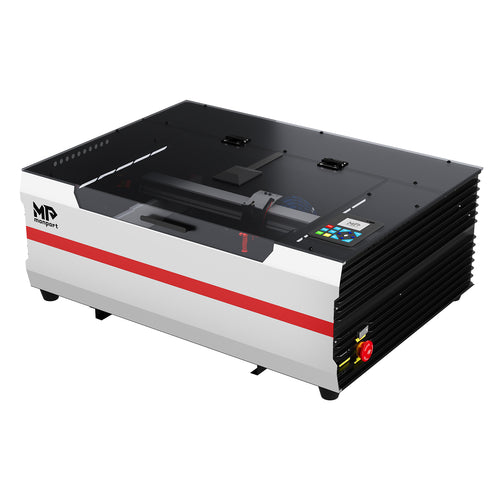
Monport has described the GPro 30W Split MOPA Fiber Laser Engraver as a manual-focus, metal-marking model. MOPA stands for Master Oscillator Power Amplifier, a fiber-laser design associated with adjustable pulse behavior. For this article, its relevance is straightforward: professionally produced metal ID tags are one possible way to create the matching barcode-inspired costume accessories described above.
That does not establish that every small code will scan, or that leather, acrylic, and all plastics are suitable for this specific model. Results depend on the actual material, artwork, and validated finished sample. For current model information, see Monport's GPro fiber laser series. The original product-specific link is not retained because its current destination could not be verified as the intended 30W model.
Safety note: Laser marking equipment should be used only in a suitably equipped setting by trained, authorized operators. This article offers costume design guidance, not equipment operating instructions or a substitute for professional safety assessment.
7. Planning a Cohesive Set of Group Costume Tags
A small planning sheet can make five very different costumes feel intentional. Keep the badge dimensions, graphic language, and typography consistent; then vary each member's fictional role, number, and short description. Decide whether the codes are decorative or need to function before approving the artwork. Finally, judge the finished tags as costume accessories: they should be readable, safe to wear, and appropriate to the theme.
For other costume projects with different materials and designs, explore Monport's articles on DIY Halloween costume ideas and custom Halloween costume accessories. Those broader guides cover a different creative angle, while this article focuses on a coordinated barcode-ID concept.
8. Frequently Asked Questions
Do costume barcodes need to scan?
No. A decorative barcode pattern works well for an inventory, science-fiction, or supermarket theme. Only describe a code as scannable if the finished item has been validated for the intended scanner and use.
Can a QR code on a costume link to a website?
Yes, when a correctly encoded QR code is readable and the destination remains available. A QR code is generally more convenient for phone-based web links than a traditional retail-style one-dimensional barcode. Check it on the actual finished accessory before the event.
Can the Monport GPro 30W mark any costume material?
No. Material compatibility depends on the precise material and surface finish. Metal tags are a more relevant example for this fiber-laser discussion; plastic, acrylic, and leather should not be treated as universally suitable. Consult the appropriate manufacturer documentation and trained operators.
What should every member's Halloween ID tag include?
A readable fictional name or role, a unique number, and a design that matches the group theme are enough. Use the same general tag layout across the group so each character looks like part of the same story.
Conclusion
The strongest barcode-themed group Halloween costumes tell a shared story through small, consistent details. A sci-fi crew, strange factory shift, escaped lab team, inventory squad, or haunted supermarket can all use personalized ID tags without relying on complicated props. Choose the visual effect first, decide whether a barcode or QR code actually needs to work, and confirm the final accessory's suitability and readability rather than assuming that laser marking guarantees it.