Looking for the best CO₂ laser cutter for small business? Discover profitable products you can make and sell in 2026, from personalized gifts and home décor to signs, packaging, and small-batch products.
Starting a laser engraving business is not simply about buying a machine and cutting materials. The real opportunity comes from choosing products that customers actually want, can be produced efficiently, and offer enough margin to make the business worthwhile.
In 2026, a CO₂ laser engraver can be used for much more than basic nameplates or wooden signs. With the right workflow, creators and small businesses can produce personalized gifts, wedding décor, retail displays, packaging, ornaments, acrylic products, and repeat-order items.
For sellers on Etsy, Shopify, craft marketplaces, or local businesses, the best CO₂ laser cutter for small business should therefore be evaluated based on productivity, precision, material capability, software compatibility, and how easily it can handle repeated orders.

What Makes a Laser Product Profitable?
Before choosing what to sell, consider four factors:
- Material cost: How much does each product cost to make?
- Production time: How quickly can you cut, engrave, assemble, and package it?
- Customization: Can personalization justify a higher selling price?
- Repeatability: Can you produce multiple identical products without excessive manual work?
A product does not necessarily need to be expensive to sell. Small products with low material costs and efficient production can become attractive when customers order them in quantities.
That is where a capable 70W CO₂ machine can make a difference.
10 Products to Make and Sell With a CO₂ Laser in 2026
1. Personalized Wooden Signs


Personalized signs remain one of the most practical laser-business products because they can be adapted to different occasions and customer preferences.
Examples include:
- Family name signs
- Wedding welcome signs
- Business signs
- Nursery signs
- House-number plaques
- Inspirational wall décor
- Restaurant and café signs
Wood also gives sellers considerable design flexibility. You can combine cutting and engraving to create layered signs rather than selling a simple engraved board.
For small businesses, offering customization can be more valuable than competing purely on price.
2. Personalized Wedding and Event Décor


Weddings, birthdays, baby showers, and corporate events create opportunities for products that customers need in sets.
Consider making:
- Table numbers
- Place cards
- Cake toppers
- Wedding invitations
- Seating charts
- Guestbook signs
- Centerpiece names
- Acrylic menu signs
- Custom favors
The advantage is that one customer may purchase dozens of pieces instead of a single item.
A machine with batch-production capabilities becomes particularly useful here. Instead of processing each design individually, multiple pieces can be arranged and produced in one workflow.
3. Acrylic Keychains and Bag Tags


Small personalized products are ideal for online sellers because they are relatively easy to package and ship.
Acrylic can be used for:
- Keychains
- Bag tags
- Name tags
- Pet tags
- Luggage tags
- Desk accessories
- Small promotional products
You can create different shapes, colors, fonts, and themes to build collections rather than relying on one product.
For example, a seller could offer customized name keychains for children, personalized pet tags, and branded keychains for small companies using the same basic production workflow.
4. Personalized Home Décor
Home décor gives laser businesses a broad product category to explore.

Popular concepts include:
- Layered wall art
- Wooden quotes
- Geometric decorations
- Custom family artwork
- Door signs
- Plant markers
- Decorative shelves
- Memorial pieces
Precision becomes increasingly important when designs contain small lettering, intricate patterns, or multiple layers.
A CO₂ laser with a fine spot size can help reproduce detailed designs more consistently, particularly when the product depends on clean lines and small engraved elements.
5. Engraved Cutting Boards and Kitchen Gifts


Personalized kitchen products are another attractive category for small businesses.
Examples include:
- Cutting boards
- Charcuterie boards
- Serving trays
- Wooden utensils
- Recipe boards
- Kitchen signs
Instead of selling a generic cutting board, a business can turn it into a personalized gift with a family name, recipe, date, or custom illustration.
This demonstrates an important laser-business principle: the value often comes from personalization rather than the raw material itself.
Always verify that the specific material and finish are appropriate for the intended food-contact application, and follow manufacturer and material-supplier guidance.
6. Business Signs and Retail Displays


Laser businesses do not have to focus exclusively on consumers.
Local businesses can become valuable customers for:
- Countertop signs
- QR-code displays
- Product holders
- Menu boards
- Logo plaques
- Retail displays
- Promotional signage
- Branded office décor
This category can also lead to repeat orders.
For example, a café might initially order a branded countertop sign and later request table numbers, promotional displays, menu holders, and seasonal decorations.
That makes B2B work worth considering alongside Etsy or Shopify sales.
7. Personalized Ornaments and Seasonal Products
Seasonal products can create strong short-term demand.

A CO₂ laser can produce ornaments from suitable materials such as wood and compatible acrylic, including:
- Christmas ornaments
- Memorial ornaments
- Wedding ornaments
- Baby's first Christmas decorations
- Pet ornaments
- Personalized gift tags
- Holiday signs
The key is to prepare designs before the seasonal rush.
Batch production can become especially important because seasonal orders may arrive in large quantities over a relatively short period.
8. Custom Packaging and Product Inserts
Laser cutting is not limited to products customers display. It can also support other businesses behind the scenes.
Examples include:
- Product inserts
- Custom boxes
- Display stands
- Branded packaging components
- Jewelry presentation boxes
- Product holders
- Decorative packaging
For a small laser business, selling packaging components to other small businesses can create an additional revenue stream.
A jewelry maker, for instance, may need dozens or hundreds of branded inserts rather than just one item.
9. Custom Jewelry and Display Products


Laser-cut products can also be used to create:
- Earring displays
- Necklace organizers
- Ring holders
- Jewelry boxes
- Retail display stands
- Small countertop organizers
Intricate cut patterns can turn relatively simple materials into visually distinctive products.
For sellers, the ability to produce the same design repeatedly is important. Consistent cutting reduces the amount of sanding, trimming, and reworking required after production.
10. Personalized Corporate and Promotional Products
Small businesses can also target corporate customers.

Potential products include:
- Branded desk signs
- Employee gifts
- Logo plaques
- Awards
- Promotional keychains
- Custom nameplates
- Event merchandise
- Branded wooden gifts
Corporate orders can be especially interesting because the customer may need a quantity of identical products.
This is another situation where production speed and batch engraving matter more than simply having the smallest or cheapest laser.
Why Production Capability Matters for a Small Laser Business
Once orders increase, the biggest challenge may no longer be designing products. It can be producing enough units efficiently.
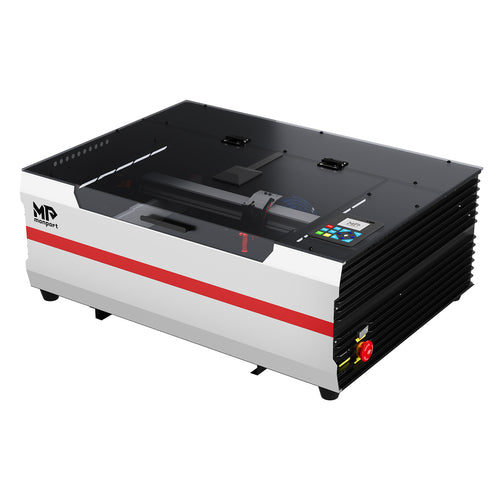
The Monport MEGAS 70W CO₂ Laser Engraver & Cutter is designed around this type of workflow, combining a 70W CO₂ laser with features intended for detailed engraving and small-batch production.
Its reported engraving speed reaches up to 600 mm/s, while its optical system is designed for fine engraving detail. Depending on the lens configuration, Monport also lists a minimum spot size of 0.03 mm with a 1.5-inch focus lens, while its commonly specified spot-size range is 0.05–0.08 mm. For production planning, users should always verify the exact lens and configuration being used.
The machine also includes features such as:
- Camera alignment
- Autofocus
- Batch engraving
- Visual Canvas
- Batch Fill
- AI-assisted image and text processing
- Conveyor compatibility
- LightBurn compatibility
- Wireless connectivity and camera functions through supported LightBurn workflows
These features matter because a profitable laser workflow involves much more than cutting power.
Precision Can Affect the Products You Sell
When making products with small text, logos, decorative patterns, or intricate artwork, laser spot size can influence the level of detail that can be reproduced.
The MEGAS is designed around a fine spot size, with Monport specifying 0.05–0.08 mm for its precision positioning and also promoting a 0.03 mm minimum spot with a 1.5-inch focus lens.

For a small business, precision can translate into practical benefits:
Fine lettering: Useful for names, dates, and small branding.
Detailed artwork: Helpful for illustrations and decorative patterns.
Cleaner edges: Can reduce the need for excessive post-processing.
Repeatability: Consistent settings can help reproduce the same product across multiple orders.
However, laser results also depend on the material, focus, lens, speed, power, air assist, and other settings. A smaller theoretical spot does not automatically guarantee better results on every material.
Why Batch Production Is Important
Imagine receiving an order for 50 wedding table numbers.
With a basic hobby workflow, you might process each piece individually. That increases setup time and creates more opportunities for inconsistency.
A production-oriented workflow allows multiple designs to be arranged and processed efficiently.

MEGAS includes Smart Batch Fill, Visual Canvas functionality, and conveyor compatibility to support larger or repeated jobs.
For Etsy and Shopify sellers, this can be useful when a product becomes popular and orders increase.
The goal is not simply to make one excellent product. The goal is to make the same excellent product repeatedly.
LightBurn Compatibility for a Flexible Workflow
Software is another important consideration when choosing the best CO₂ laser cutter for small business.
LightBurn is widely used for laser design and machine control, and compatible MEGAS workflows support functions such as autofocus, wireless connectivity, and wireless camera operation within LightBurn.

That can simplify the process from digital design to physical production.
A typical workflow might look like this:
Step 1: Design
Create or import an SVG, DXF, PNG, or other compatible file.
Step 2: Arrange
Use the workspace to position multiple products efficiently.
Step 3: Camera Alignment
Use the camera system to help position artwork and materials.
Step 4: Set Parameters
Choose appropriate speed, power, passes, and focus settings for the material.
Step 5: Test
Run a small material test before a large production order.
Step 6: Batch Produce
Once the settings are verified, process the larger order.
This approach reduces unnecessary material waste and makes production more repeatable.
Choosing the Best CO₂ Laser Cutter for Small Business
The best machine is not necessarily the cheapest machine or the most powerful industrial system.
For a growing business, look at the complete workflow.
| Feature | Hobby Laser | MEGAS 70W | Industrial CO₂ Laser |
|---|---|---|---|
| Small-batch production | Limited | ✅ Strong | ✅ Excellent |
| High-speed engraving | Limited | ✅ Up to 600 mm/s | ✅ |
| Batch workflow | Basic | ✅ | ✅ |
| Camera workflow | Varies | ✅ | Varies |
| Autofocus | Varies | ✅ | Often available |
| LightBurn workflow | Varies | ✅ | Varies |
| Workspace | Smaller | Large desktop format | Large |
| Investment | Lower | Mid-range | High |
| Best suited for | Hobby projects | Growing small businesses | Manufacturing |
For many creators, the middle ground can be the most practical. A hobby machine may become restrictive as orders grow, while a large industrial system can require substantially more space, investment, and operational experience.
A 70W desktop CO₂ machine sits between those two extremes, offering substantially more production capability without requiring a full factory-scale setup.
FAQ
What is the best CO2 laser cutter for a small business?
The best laser machine depends on the products, materials, workspace and expected production volume. For businesses producing personalized wood, acrylic and other compatible materials, a machine with sufficient power, precision, automation and reliable software support can provide a more flexible production workflow.
What are the most profitable things to make with a CO2 laser?
Personalized signs, wedding products, acrylic décor, custom gifts, business signage and home décor are popular categories to investigate. Profitability depends on material costs, production time, pricing, demand and marketing.
Is a 70W CO2 laser good for a small business?
A 70W CO2 laser can be useful for small-business production because it provides enough power for a range of cutting and engraving applications. The appropriate wattage ultimately depends on the materials, thicknesses and production requirements.
Can a CO2 laser engrave acrylic and wood?
Yes. CO2 lasers are commonly used for cutting and engraving compatible wood and acrylic materials. Always verify the specific material composition and manufacturer safety recommendations before processing a material.
Is LightBurn important for a laser engraving business?
Software can have a significant effect on workflow efficiency. LightBurn provides design and laser-control capabilities, while compatible machines may support features such as autofocus, wireless connectivity and camera functions within the software.
Final Thoughts: Build Products Around Your Customers
The most profitable laser products are not necessarily the most complicated ones.
A simple personalized sign can outperform a highly detailed product if customers understand its value and you can produce it efficiently.
Start by identifying a specific customer group. For example:
- Wedding planners
- Etsy gift shoppers
- Pet owners
- Home décor buyers
- Local restaurants
- Small retailers
- Corporate event organizers
- Other handmade-product businesses
Then create a small collection of products around that audience.
The best CO₂ laser cutter for small business should support that strategy by giving you enough power, precision, automation, workspace, and production flexibility to move from one-off projects toward repeatable small-batch manufacturing.
For creators planning to scale in 2026, a machine such as the Monport MEGAS 70W can serve as a bridge between hobby laser engraving and more demanding commercial production—particularly when speed, detailed engraving, batch processing, camera alignment, and LightBurn compatibility are important parts of the workflow.
The biggest opportunity is not simply owning a laser. It is using the laser to create products people are willing to buy repeatedly.