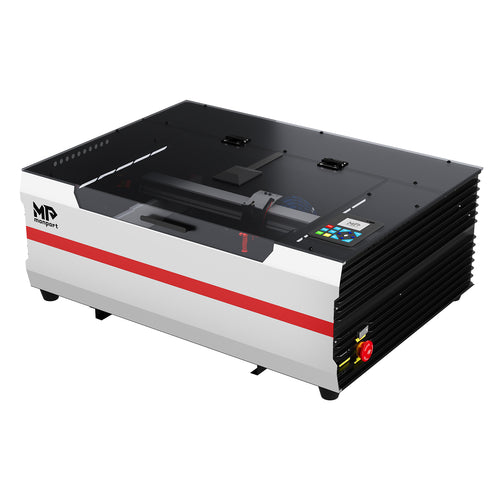
Choosing between autofocus and manual focus can affect how much time you spend preparing jobs, switching between products, and training operators. For a small laser engraving business, autofocus is worth considering when material thickness changes frequently. Manual focus can be sufficient when jobs use a stable, repeatable setup and operators can establish the correct focus consistently.
Neither method automatically produces better engraving quality or faster processing. The decision comes down to your machine's focusing system, the materials you process, your order mix, and the actual cost difference between suitable machines.
This guide focuses mainly on desktop CO2 laser engravers. Other laser systems may use different focusing mechanisms, so always check the specifications and operating instructions for the exact model you are considering.

Quick Answer: Which Focusing Method Fits Your Business?
| Your production situation | What to prioritize |
|---|---|
| Frequent changes in material thickness | Autofocus, provided its sensing system is compatible with your materials |
| Repeated jobs using the same material and fixture | Consistent setup and whether manual refocusing is actually necessary |
| Curved, uneven, or difficult-to-detect surfaces | Sensor limitations, workpiece positioning, and approved focusing procedures |
| Several operators sharing a machine | A repeatable procedure that staff can follow and verify |
| Tight equipment budget | Total machine cost, measured setup time, and realistic financial benefits |
Autofocus is most useful when it removes a recurring preparation task. Manual focus remains a reasonable option when the existing workflow is already consistent. Neither should take priority over essential requirements such as material compatibility, working area, laser power, and the machine's overall configuration.
Autofocus vs. Manual Focus: The Key Differences
Laser focusing establishes the relationship between the material and the focal plane of the installed lens. The correct position depends on the lens, material, and intended operation. The focusing method determines how that position is established; it does not determine laser power or processing speed.
How Autofocus Works
An autofocus system uses a sensing mechanism and machine controls to establish the appropriate focus position. Depending on the design, the system may adjust the laser head, the worktable, or another part of the focusing mechanism.
The detection method matters. Some systems depend on a suitable surface or detection point, and not every sensor can handle every material or workpiece shape.
Monport describes the MEGAS 70W desktop CO2 laser engraver as featuring smart thickness sensing. Its MEGAS beginner's guide describes the integrated system as LiDAR autofocus. Check the current product configuration and the corresponding manual for the exact operating procedure.
Autofocus can reduce manual height adjustments on compatible jobs. It does not automatically select the correct power and speed settings, position artwork, flatten a warped sheet, or compensate for every change in workpiece height.
How Manual Focus Works
Manual focus uses a manufacturer-approved procedure to establish the working distance. On many CO2 laser engravers, this involves a focus gauge or another reference designed for the machine and installed lens.
The operator checks the material height, follows the specified procedure, and adjusts the relevant component when required. With practice, this process can be straightforward, especially when the same setup is used repeatedly.
Manual focus is not synonymous with manually moving the Z-axis, nor does every machine with autofocus support an alternative manual procedure. If you intend to use a different focusing method, confirm that the manufacturer permits it for your model.
How the Two Methods Compare
| Comparison factor | Autofocus | Manual focus |
|---|---|---|
| Setup process | Uses the machine's automatic sensing and adjustment mechanism | Requires the approved manual focusing procedure |
| Frequent thickness changes | Can simplify focus adjustments on compatible materials | Requires the operator to reset or verify focus as needed |
| Repeated production | Useful when focus must be established frequently | Practical when material height and fixtures remain consistent |
| Operator training | Can reduce the number of manual adjustment steps | Requires familiarity with the focusing tool and procedure |
| Irregular surfaces | Depends on the sensor, detection conditions, and machine configuration | May be suitable when an approved manual method accommodates the workpiece |
| Maintenance | Sensors and associated mechanisms may need inspection | Focus gauges and other references must be kept in good condition |
| Finished quality | Depends on correct focus and processing conditions | Can also produce good results with a correct setup |
Neither column guarantees a particular result. Focusing systems differ by machine, and the same method can behave differently with different lenses, materials, and workpiece arrangements.
When Does Autofocus Make More Sense for a Small Business?
Autofocus has the clearest practical value when your production workflow requires frequent focus adjustments. The benefit depends on how often those adjustments occur and how much preparation time the automatic process actually removes.

Switching Between Products of Different Thicknesses
Consider a workshop that engraves thin wooden coasters in the morning and thicker wooden signs in the afternoon. Changing the material or its position can change the distance between the lens and the work surface.
A compatible autofocus system can simplify the adjustment between jobs. This may help businesses producing personalized gifts, nameplates, signs, and other products with different thicknesses.
However, thickness is only part of the setup. A raised fixture or holder can change the height of the actual engraving surface. The operator still needs to position the workpiece correctly and confirm that the autofocus system can detect the relevant surface.
Handling Personalized and Short-Run Orders
Custom-product businesses often switch between designs, materials, and product sizes throughout the day. Each change may involve artwork preparation, material loading, workpiece positioning, focus adjustment, and processing-setting checks.
Autofocus addresses only the focusing part of this process. Its value is greater when focus adjustment is a recurring task rather than an occasional step.
If loading, securing, and aligning each item take substantially more time than focusing, autofocus alone may make only a modest difference to the complete order workflow.
Training a Growing Team
When several operators share a machine, a repeatable focusing process can make training easier. Autofocus may reduce reliance on manual adjustments, but operators still need to understand material compatibility, verify the setup, and recognize when the automatic process is unsuitable.
For an experienced operator producing identical items all day, the difference may be less significant. Working area, power, software compatibility, ventilation, and service support may have a greater influence on the purchase decision.
When Is Manual Focus the Better Choice?
Manual focus can be a sensible choice when the production process is stable, operators are familiar with the equipment, and focus adjustments are infrequent.
Repeating the Same Product Setup
Suppose a workshop produces a batch of identical wooden products using the same material thickness and fixture. Once the setup has been verified, the operator may not need to make substantial focus adjustments between pieces.
In this situation, autofocus may save little preparation time between items. Both methods still require attention to material placement and any changes that could affect the working distance.
A previously verified setting should not be assumed to remain correct after changing the lens, material height, fixture, or relevant machine configuration.
Working With Irregular or Difficult-to-Sense Surfaces
Some autofocus systems have difficulty detecting particular surfaces or workpiece shapes. Openings, transparent surfaces, soft materials, and uneven objects can present challenges, depending on the sensing mechanism.
Manual focusing is an option only when the machine's approved procedure accommodates the workpiece. It does not solve every problem caused by a curved or warped surface: focusing at one point cannot ensure that all other points remain at the same distance from the lens.
Before purchasing a machine for unusual products, ask the manufacturer to confirm the supported focusing method and any workholding requirements. Do not improvise a sensor target or bypass a safety function.
Keeping Equipment Costs Under Control
A limited budget makes it especially important to compare complete machine configurations rather than individual features.
Consider the working area, laser power, material compatibility, software, safety provisions, ventilation requirements, support, and focusing method together. A machine with manual focus may cost less in one comparison, but that is not guaranteed across all brands and configurations.
If two suitable machines have different prices, identify the actual source of the difference. Then decide whether the time saved by autofocus would provide enough practical value to justify the additional investment.
Does Autofocus Improve Laser Engraving Accuracy?
Autofocus can help establish the correct focus position, but it does not automatically make an engraving sharper or more precise than one produced with manual focus.
The position of the focal plane is a process variable. In a 2025 study of CO2 laser engraving on birch plywood, researchers examined different focal-plane positions alongside different laser power and scanning-speed settings, measuring changes in the plywood's surface color. The findings illustrate why focus should be evaluated together with the material and processing conditions, rather than treated as a universal setting. (Gochev and Vichev, Drvna industrija)
A separate review of CO2 laser cutting of polymeric materials also discusses how focal-point position influences cutting quality. Its findings concern specific cutting processes and materials; they do not establish that autofocus is inherently more accurate than manual focus. (Review of CO2 laser cutting of polymeric materials)
What Autofocus Cannot Fix
An automatic focusing system does not correct every cause of poor engraving or cutting results. Material warping, an unsuitable lens, contamination, alignment problems, unstable fixtures, and incorrect processing parameters can all affect the finished work.
Camera positioning is another separate function. A camera can help an operator preview artwork placement, while autofocus establishes the working focus position. Neither function should be assumed to perform the other's job.
How to Test Autofocus and Manual Focus for Your Own Jobs
Use a representative material and product before deciding whether one focusing method works better for your business.
- Select a typical workpiece and a second sample with a different thickness, if relevant to your orders.
- Follow the approved focusing procedure for each method, using the appropriate lens and fixture.
- Record the full setup time, including verification and necessary handling—not just the time spent adjusting focus.
- Run the same design with comparable, verified processing conditions. Inspect fine details, edge definition, cutting completeness, and repeatability across multiple samples.
- Record material flatness, lens condition, alignment, and any other differences that could affect the result.
If you compare different machines, remember that their lenses, mechanics, controls, and other hardware may differ too. Without controlling those variables, you cannot attribute every difference in the finished work to autofocus or manual focus alone.
Is Autofocus Worth the Cost? A Practical Calculation
The most useful way to evaluate autofocus is to measure how much preparation time it saves in your own workflow. Record the time required to establish focus using the current method, then measure the alternative method on comparable jobs. Include the necessary checks and handling steps.

1. Time saved per setup: Manual setup time − Autofocus setup time.
2. Estimated annual hours saved:
Annual hours saved = (Minutes saved per setup × Setups per week × Working weeks per year) ÷ 60
3. Estimated annual labor-time value:
Annual labor-time value = Annual hours saved × Hourly labor cost
These formulas estimate the value of time saved; they do not guarantee additional revenue or an equivalent reduction in cash expenses.
| Information to record | Why it matters |
|---|---|
| Number of focus setups per week | Establishes how frequently the feature could be used |
| Average time for each method | Measures the actual preparation-time difference |
| Working weeks per year | Reflects your operating schedule |
| Hourly labor cost | Estimates the value of the saved labor time |
| Difference in equipment cost | Identifies the additional investment, if any |
| Additional operating costs | Accounts for relevant extra expenses |
You can then estimate whether the investment could pay for itself.
Estimated monthly net benefit: (Realizable annual labor-time value ÷ 12) − Additional monthly operating costs.
Payback period in months: Additional equipment cost ÷ Estimated monthly net benefit.
Use the payback formula only when the estimated monthly net benefit is positive. If the saved time cannot be put to productive use, the theoretical labor-time value should not be treated as a guaranteed financial return.
Also compare the actual prices of the machines you are considering. If autofocus is included in the standard configuration, use the difference in total purchase cost rather than assuming the feature has a separate price.
What Should You Check Before Buying a Laser Engraver?
Before choosing a machine, test its focusing workflow against the products you expect to make. A short demonstration can reveal limitations that a feature list cannot.
- Confirm the focusing method. Ask which sensing or manual procedure the machine uses, and whether it supports an alternative focusing method.
- Test typical product heights. Try a standard item and another with a different thickness, including the holder or fixture used in normal production.
- Check material compatibility. Confirm whether the sensing system can detect your intended surface reliably. Do not assume every transparent, soft, curved, or uneven material is supported.
- Review maintenance and support. Ask how to verify focus, address sensor problems, and handle changes to the lens or focusing assembly.
- Separate the automation features. Evaluate autofocus, camera positioning, and batch processing independently because they solve different problems.
- Compare the complete configuration. Consider the working area, power, compatible materials, software, safety provisions, and support alongside the focusing method.
For example, Monport's MEGAS 70W desktop CO2 laser engraver lists autofocus, an 8MP camera, and batch-production capabilities. These features address different parts of a production workflow: establishing focus, previewing or positioning designs, and processing multiple items.
Monport's MEGAS setup and beginner's guide provides further information about the machine and its operation. Check the current US product configuration and the relevant manual before relying on a specific procedure or compatibility claim.
Frequently Asked Questions
Is autofocus worth it for a small laser engraving business?
It may be worth considering if you frequently change product thicknesses or repeatedly need to establish focus. If you mainly produce identical items with a stable, verified setup, manual focus may be sufficient. Measure your setup time and compare the actual equipment costs before deciding.
Is manual focus accurate enough for commercial laser engraving?
Manual focus can produce consistent results when the operator follows the correct procedure for the installed lens and machine. Material condition, processing settings, and machine setup also affect quality. Test samples should meet your requirements before you begin a production batch.
Does autofocus make a laser engraver faster?
Autofocus can reduce some focus-setting work, but it does not automatically increase the laser's processing speed. The total time saved depends on how often focus must be established and how much of the overall workflow that step occupies.
Can I use manual focus on a machine with autofocus?
That depends on the machine and its approved focusing procedures. Some machines support alternative manual methods; others require a specific procedure. Check the manufacturer's instructions before attempting to change the focusing method.
What matters more for a small business: autofocus or laser power?
They address different requirements. Laser power influences processing capability, while autofocus changes how the focus position is established. Compare both alongside the working area, material compatibility, software, safety provisions, and your expected order mix.
Choose the Focusing Method That Fits Your Production Workflow
Autofocus is most valuable when frequent product changes make focusing a recurring preparation task and the sensing system suits your materials. Manual focus remains practical for businesses that use stable setups and can establish focus consistently.
Measure your actual setup time, compare the complete machine configurations, and consider whether saved time can be used productively. For broader planning around equipment, applications, and production needs, explore Monport's laser engraving resources for small businesses.