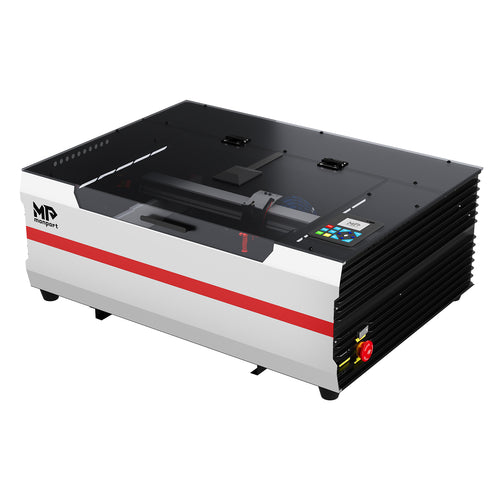
UV and fiber laser engravers are suited to different materials and marking objectives.Ultraviolet systems are associated with fine marking and comparatively limited thermal effects on certain sensitive surfaces. Conventional infrared fiber systems are widely used for metal identification and engraving. Neither technology is automatically more accurate, safer, or better suited to every material.
Consider two marks on the same stainless steel plate: a dark identification code and a recessed inscription. Both are described as laser marks, yet they require different surface changes. The question is not merely whether a laser can leave a visible mark. It is what must happen to the material, and what evidence shows the finished mark meets its requirements.

UV vs Fiber Laser Engraver: Key Differences
Most industrial UV marking systems discussed in this category operate near 355 nm, while many infrared fiber marking systems operate near 1064 nm. These are typical wavelengths rather than specifications shared by every laser product. Wavelength influences absorption, but the result also depends on the material, optics, beam characteristics, and the entire marking system.
| Characteristic | UV laser marking | Infrared fiber laser marking |
|---|---|---|
| Typical wavelength | Around 355 nm | Around 1064 nm |
| Common application emphasis | Fine marks on selected glass, polymers, ceramics, and coatings | Identification and engraving on compatible metals |
| Surface effect | May offer a smaller heat-affected region for suitable materials | Often relies on thermal surface modification or material removal |
| Metal material removal | Not usually the primary application | Common industrial application, depending on system and required depth |
| Precision claim | Requires evidence of actual feature size and consistency | Requires the same evidence; wavelength alone is insufficient |
| Main qualification | “Cold marking” does not mean zero heat or universal compatibility | “Fiber laser” does not identify one fixed pulse format or result |
A visible, high-contrast mark is different from a groove of specified depth. This distinction is more useful than a blanket claim that one laser type is “more powerful” or “more precise.”
What Is Different About UV and Fiber Laser Technology?
UV wavelengths and material interaction
A shorter wavelength changes how light is absorbed and focused, which can be significant for some polymers and transparent materials. Some UV processing involves photochemical changes; other cases involve both chemical and thermal effects. A peer-reviewed review, Interaction of Photons with Polymers: From Surface Modification to Ablation, describes polymer ablation as a combination of photochemical and photothermal mechanisms, with the balance depending on polymer properties.
That distinction matters because cold marking is shorthand, not a promise that the material receives no heat. Describing every UV mark as damage-free would overstate what a wavelength alone can establish. Even closely related polymers can differ in composition, colorants, fillers, and optical absorption.
Infrared fiber lasers and metal marking
Fiber lasers use an optical fiber as their gain medium; many commercial marking systems operate at an infrared wavelength around 1064 nm. Their interactions with metals can produce changes in color, surface texture, oxide layers, or material depth. These are different physical outcomes and need not have the same durability or appearance.
The laser source is only one part of the system. Optics, positioning, motion, calibration, and material response affect the final feature. A nominal beam specification should not be treated as a guarantee of line width or finished-mark accuracy.
Material Compatibility Depends on the Result, Not Just the Material Name

Metals: appearance changes versus recessed engraving
Metal applications illustrate why terms matter. A serial-number mark may only need to remain readable under defined service conditions. A decorative metal design may prioritize contrast and finish. A recessed engraving has a measurable depth requirement. All three may be called engraving in general descriptions, even though they are not equivalent.
Infrared fiber systems are associated with a broad range of industrial metal-marking applications, including stainless steel, aluminum, brass, and titanium. UV systems can also affect selected metal surfaces and coatings. Neither category guarantees a particular mark without accounting for the alloy, finish, treatment, and quality requirements. Even a dark mark should not be assumed to be deeply engraved or permanently legible in every environment.
Glass and crystal: the surface is not the interior
Glass marking is often associated with UV technology, but different kinds of glass do not necessarily respond in the same way. Composition, coatings, existing stresses, and the optical configuration influence whether a particular result is possible.
A frosted exterior design and an image formed inside a transparent crystal are separate processes. Subsurface marks require a system designed and validated for internal interaction, not merely a system described as capable of marking glass surfaces. Technical descriptions should distinguish these outcomes and avoid implying that any UV marker can reproduce three-dimensional internal artwork.
Nor should “low thermal impact” be translated into “cannot crack glass.” Crack resistance depends on the material and the actual process, not a marketing label.
Plastics, acrylic, silicone, and composites
Plastics are not a single uniform substrate. The name on a product description may omit the polymer grade, pigments, additives, layered construction, or coating. Each can alter the material’s optical response. Two visually similar plastic components may therefore develop different marks under comparable exposure.
UV marking may be relevant when fine detail and a limited heat-affected area matter. Certain formulations also respond to infrared fiber marking. This is a material-science distinction, not permission to treat every polymer as safe for laser processing.
A material being technically markable does not establish that it is safe to process. The MIT Environment, Health & Safety guidance on laser cutters specifically warns that PVC can release dangerous hydrogen chloride gas during laser cutting. That guidance addresses laser cutters rather than every conceivable marking system, but it illustrates why unknown or poorly documented compositions require professional review rather than casual assumptions.
Ceramics and coated surfaces
A glazed ceramic tile, a technical ceramic component, and a coated metal plate present different surfaces to the beam. The glaze, coating, and underlying substrate may not respond alike. Apparent success on a coated surface can reflect alteration of the coating instead of engraving the material beneath it. That difference is relevant to appearance, service life, and acceptance requirements.
When both technologies can produce a visible mark
When more than one laser technology is capable of changing a surface, the meaningful comparison is the resulting feature. Does the visible mark meet the contrast or legibility requirement? Is the surface altered beyond what is acceptable? Does the finished feature retain its required dimensions and appearance? Can an accredited or qualified testing process demonstrate consistency, where applicable?
| Example object | Desired result | Main technical distinction |
|---|---|---|
| Stainless steel identification plate | Readable identification | Contrast, durability, and substrate finish are separate from engraving depth |
| Metal part with a recessed design | Measurable recess | Surface marking and material removal are different outcomes |
| Glass decorative object | External frosted mark | Material and coating determine surface response |
| Crystal display object | Internal graphic | Requires validated subsurface marking capability |
| Polymer component | Fine identification text | Composition and allowable surface change determine whether results are acceptable |
| Glazed ceramic | Visible logo | Effect on glaze may differ from effect on the ceramic beneath |
These examples are conceptual distinctions, not results from a controlled head-to-head product test.
Precision, Engraving Depth, and Speed: Three Different Questions

What does “precision” actually mean?
Precision descriptions often conflate several measurements. Optical spot size is a beam characteristic. Positioning accuracy describes how closely an indicated location corresponds to an intended position. Mark width describes what actually appears on the material. Repeatability concerns consistency across repeated marks. These terms cannot be substituted for one another.
A smaller spot can be useful for small features, but a material may respond across an area different from the optical spot. The final result is also influenced by the full optical and scanning arrangement. Comparisons based solely on one nominal spot-size figure are therefore incomplete.
Surface marking versus material removal
A surface mark may rely on color change, oxidation, coating modification, or shallow material removal. Deep engraving involves creating a pronounced recess. Marking depth and mark appearance should therefore be reported separately, especially for industrial identification applications. It is not technically sound to compare the durability of an identification mark solely by visual darkness, or to infer engraving depth from a photograph.
Advertised scanning speed versus accepted output
A scanner’s maximum movement specification is not the same as time per finished piece. Overall throughput can also be affected by handling, part placement, inspection, the area of the mark, and the amount of material change required. A technically faster motion system does not automatically yield more accepted finished parts in a real production environment.
For professional evaluation, the relevant measure is the quality and consistency of completed work under an agreed acceptance standard—not a single maximum figure from a brochure. Without comparable, independent testing, manufacturer speed specifications should not be presented as head-to-head production results.
How Does

Fiber Technology Fit Into This Comparison?
MOPA stands for Master Oscillator Power Amplifier. In this context it refers to a pulsed laser architecture, not a UV wavelength and not a wholly separate material category. MOPA fiber lasers remain fiber lasers, but they can offer additional control over pulse characteristics compared with some conventional pulsed fiber designs.
Such control can affect the nature of the resulting metal surface mark. Research published in the Vietnam Journal of Science and Technology examined color-marking effects on stainless steel and titanium using a MOPA fiber system and found that laser-process variables affect the colors obtained. Other research into oxide layers in stainless steel color marking likewise connects surface characteristics with color formation.
These findings support an important distinction: colored metal marks are material- and process-dependent surface effects, not equivalent to applying full-color ink. They also do not mean all fiber lasers, all metals, or all MOPA systems produce the same palette. The studies cannot be used to infer the performance of a specific commercial machine without separate evidence.
Cost and Production Claims Need Comparable Evidence
UV and fiber marking systems have different equipment designs and maintenance needs, but there is no reliable universal price ranking that applies across power levels, optical configurations, protection arrangements, and production capabilities. An advertised machine price may exclude essential workplace safeguards, inspection requirements, or technical support.
Operating costs also depend on the approved facility, maintenance provisions, handling time, rejected material, and downtime. For a business-case assessment, the term cost per accepted part is useful only if all relevant costs and the number of accepted finished parts are measured over the same time period. A simple arithmetic result built from inconsistent assumptions is not a meaningful performance comparison.
A claim such as “faster,” “more precise,” or “lower cost” needs a defined comparison group, a measurement method, and the conditions under which it holds. This is especially important for claims drawn from manufacturer specifications that are not independent tests.
What Should a Professional Technical Review Verify?
Before any hazardous laser-marking system is approved for a workplace, a qualified technical and safety review should address several distinct questions. The material must be correctly identified, and the intended feature should have clear acceptance criteria. Manufacturer documentation must describe the complete equipment configuration rather than a source specification in isolation. Any claims about optical precision, material compatibility, throughput, or mark durability should be matched to evidence collected under relevant conditions.
The safety evaluation is separate from marking quality. The FDA's laser classification guidance and OSHA's laser hazard information describe significant risks associated with Class 4 lasers, including hazardous direct and reflected beams. A laser's usefulness for fine marking does not mean the device is safe to operate without an appropriately controlled professional environment.
These systems are industrial equipment. Their assessment, installation, and operation belong with trained, authorized professionals and applicable workplace safeguards. A promotional comparison cannot replace a documented safety review.
Frequently Asked Questions
Does a UV laser produce no heat?
No. The expression cold marking refers to comparatively limited heat effects under some conditions. Photochemical and photothermal interactions can both contribute, depending on the material and process. No laser wavelength alone guarantees a damage-free mark.
Can UV and fiber lasers mark the same material?
In some cases, yes. But the resulting color, texture, depth, and impact on the surface may differ. An observable mark is not enough to establish that it meets a particular industrial or decorative requirement.
Does shorter wavelength always mean better accuracy?
No. Wavelength influences focusing and absorption, but overall mark accuracy depends on optical design, positioning, calibration, and the material’s response. The optical spot, positioning tolerance, and actual mark dimensions must be distinguished.
Is MOPA the same thing as UV?
No. MOPA describes an oscillator-amplifier architecture often associated with pulsed fiber lasers. UV describes a wavelength range. Their roles in material processing are different, and one does not imply the other.
Are all materials listed as “laser compatible” safe?
No. A material can react visibly to laser energy while presenting hazardous emissions or other risks. The exact composition, the processing system, and the workplace safety assessment matter. Unknown materials should not be treated as approved simply because a broad compatibility list includes their general category.
Conclusion
UV and infrared fiber marking technologies differ in wavelength, material interaction, and the kinds of surface changes they commonly produce. UV may be relevant to selected fine-detail and sensitive-surface applications; fiber technology is prominent in metal identification and material removal; and MOPA provides another form of pulse control within the fiber category.
The stronger technical comparison is not “Which laser is best?” but “What result is required, what evidence supports that result, and what safety controls does the full system require?” Those are questions for documented professional evaluation rather than marketing claims alone.