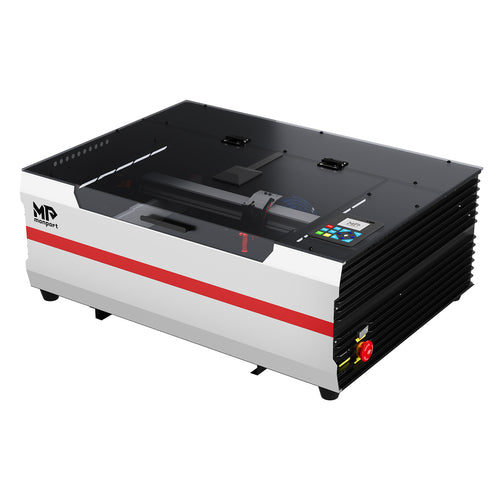
When you’re buying a desktop CO2 laser, faster laser cutting isn’t just a “nice-to-have”—it shapes your turnaround time, your batch capacity, and how quickly you can move from design to finished product. This post keeps the original “Mega vs P2” search intent, but updates the discussion to Monport’s current promoted model: Mega S.
If you want Monport’s latest Mega-family workflow and specs, start here: Monport Mega S 70W Desktop CO2 Laser Engraver & Cutter .

What “speed” really means for faster laser cutting
Manufacturers often advertise a single headline speed, but real-world faster laser cutting depends on more than that:
- Motion speed + stability: how fast the gantry moves without losing consistency.
- Cutting throughput: power + optics + airflow that help you cut cleanly with fewer slow-down passes.
- Setup time: camera preview, material presets, and repeatable positioning can save minutes per job.
- Workspace efficiency: a larger working area reduces repositioning and re-framing time.
Head-to-head: Mega S vs xTool P2/P2S (speed + workflow view)
From official listings, both Mega S and xTool P2/P2S highlight a 600 mm/s class headline speed. The better question becomes: which machine helps you stay fast across the full workflow—setup, batching, and cutting quality?
| Speed / Efficiency Factor | Monport Mega S | xTool P2 / P2S |
|---|---|---|
| Headline max speed | 600 mm/s | 600 mm/s (max engraving speed) |
| Laser power class | 70W CO2 | 55W CO2 |
| Working area (efficiency for batching) | 700 × 350 mm (27.56" × 13.78") | 600 × 305 mm (23.6" × 12") |
Why Mega S is built for faster laser cutting in real production
1) More room to run bigger jobs (and fewer repositions)
A larger working area can be an underrated path to faster laser cutting. Mega S lists 700 × 350 mm of working space, which can reduce the number of times you have to split designs or reposition material. That means fewer resets, fewer alignment checks, and more “start-and-finish” jobs.
2) Cutting performance guidance (where time savings add up)
Mega S positions itself for productivity by pairing 70W power with cutting guidance like up to 20 mm acrylic and 18 mm basswood under appropriate settings. When a machine can cut cleanly without extra slow passes, your total job time drops—especially on thicker materials.
See the latest specs and configurations here: Mega S specs for faster laser cutting .
3) Workflow options that support throughput
Faster output isn’t only gantry speed—it’s also how quickly you can move material and repeat jobs. Mega S includes options designed to support higher-throughput workflows (for example, conveyor-style setup concepts) so you can spend less time “resetting” and more time producing.

If you’re aiming for faster turnaround and more consistent production, Mega S is the Mega-family route Monport is actively positioning: Shop Mega S .
When xTool P2/P2S may still be the right fit
If you’re already invested in the xTool ecosystem and your project sizes fit comfortably within the P2/P2S working area, you may prefer staying in that workflow. xTool’s official page highlights the 55W CO2 class, a 600 mm/s max engraving speed headline, and a 600 × 305 mm working area.
The verdict: which one is better for faster laser cutting?
On paper, both families highlight similar headline speed numbers. In practice, faster laser cutting is often decided by: (1) working area efficiency, (2) cutting-throughput performance, and (3) how much setup friction you remove per job. If you want Monport’s current promoted model and a workflow that’s built around productivity, Mega S is the updated answer to the “Mega vs P2” question.